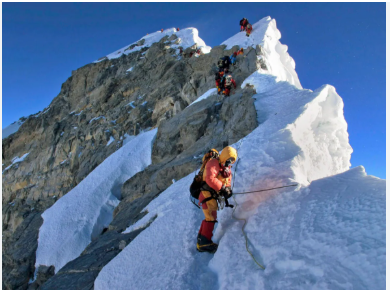
Most people see the summit photo. The triumphant climber, arms raised, the world literally beneath their feet. What they don’t see is the army of people, the months of planning, the staggering costs, and the sheer unglamorous grind that made that one photo possible. Climbing Everest isn’t a trek. It’s a full-scale logistical operation, and most people have absolutely no idea what that actually looks like.
In this blog, we’re pulling back the curtain on the real story behind an Everest expedition, cost and logistics included. We’ll walk you through everything: permits, base camp setup, the role of Sherpas, what happens above 8,000m, how much you’ll actually spend, and what seasoned climbers say when they’re finally home. Whether you’re seriously planning an attempt or just fascinated by the world’s highest mountain, this guide gives you the full, unfiltered picture.
The Scale of an Everest Expedition ,More Than Just Climbing
People often picture Everest climbing as one person versus one mountain. The reality? It’s closer to a small corporation temporarily relocating to 5,364 meters above sea level. A single commercial climber attempting the summit doesn’t go alone, they go with an entire support ecosystem built around keeping them alive and moving upward.
Think about this: for every paying client on a commercial Everest expedition, there are typically 3 to 5 support staff working behind the scenes. Base camp managers coordinate logistics on the ground. Expedition cooks prepare multiple hot meals a day at altitude ,which, trust me, is harder than it sounds. High altitude doctors monitor oxygen saturation and watch for signs of altitude sickness in every team member. Communication officers manage satellite links to weather forecasters in Europe and North America. This is not casual hiking. This is a full professional operation.
And the sheer volume of stuff involved is staggering. Hundreds of kilograms of gear, food, oxygen cylinders, ropes, tents, medical supplies and fuel have to move from Kathmandu to Base Camp and then progressively up the mountain to four high camps. Every item carried above Base Camp is carried by human hands and lungs ,mostly Sherpa climbing teams who do multiple rotations up and down the mountain while the paying clients rest and acclimatize.
What makes this even more remarkable is how invisible all of this remains to the outside world. The summit moment gets the headlines. The six weeks of work that made it possible? Almost nobody talks about that.
The Team Behind Every Summit Attempt
A standard commercial expedition team is much bigger than most people realize. Here’s a rough breakdown of who’s actually there:
- Lead climbing Sherpas ,experienced high-altitude mountaineers who fix ropes, carry loads to upper camps, and guide clients during summit push
- Base camp manager ,handles all logistics, permits, supply coordination and communication
- Expedition cook and kitchen staff ,yes, there’s an actual cook (sometimes two) and a full dining setup at Base Camp
- High-altitude doctor or paramedic ,monitors health, manages altitude illness, coordinates evacuations
- Liaison officer ,required by Nepal government, officially assigned to each expedition
- Load-carrying porters ,move gear from Lukla to Base Camp during the approach trek
- Icefall doctors team ,the unsung heroes who fix and maintain the rope and ladder systems through the Khumbu Icefall
On a premium expedition, you might have 15–20 support staff for a group of 8–12 clients. On a budget expedition, those numbers are leaner, and the trade-offs become very real very quickly.
How Long Does an Everest Expedition Actually Take?
The honest answer: plan for 60 to 70 days, minimum. Most people are genuinely shocked by this.
Here’s the basic timeline. You arrive in Kathmandu about a week before your trek begins ,gear checks, permit processing, team briefings. The trek to Base Camp itself takes roughly 8–10 days from Lukla. Once at Base Camp, you don’t just start climbing. You spend 4–5 weeks doing acclimatization rotations ,going up to Camp I and II, coming back down, resting, going up to Camp III, coming back down again. Your body needs time to produce more red blood cells and adapt to thinner air. There’s no shortcut.
After rotations, you wait for a weather window. This is perhaps the most underestimated part. Summit windows on Everest ,usually in mid-to-late May ,can be narrow, sometimes just 2–3 days. Teams from multiple expeditions all trying to hit the same window creates the bottleneck you’ve probably seen images of: long queues near the summit. Once you summit (or turn around), you descend to Base Camp, rest, then trek back to Lukla, fly to Kathmandu, and spend a day or two recovering before flying home.
Sixty days is not an exaggeration. It’s the reality.
Everest Expedition Permits and Legal Requirements
Before your boots touch the mountain, Nepal’s government wants to know you’re coming ,and they want to be paid. The permit system for climbing Everest is one of the most formalized in the world, and navigating it is genuinely complex.
Nepal’s Ministry of Tourism issues climbing permits for the south side of Everest (the most popular route). For the 2025 spring season, the permit fee was $11,000 per person for the south col route. This fee is non-negotiable and non-refundable regardless of whether you summit or even reach Base Camp. It’s just the entry ticket. Many climbers are surprised to learn that this permit alone covers only the right to attempt the mountain ,everything else costs extra.
It’s also worth noting that the north side of Everest (the Tibetan route) has a different permit system managed through Chinese authorities. Historically this has been cheaper but involves its own bureaucratic complexity, and Tibet access has been restricted at various points in recent years making the Nepal side the default for most international expeditions.
Nepal Government Climbing Permits
The core permit structure as of 2026 season:
- Sagarmatha (Everest) Climbing Permit ,approximately $11,000 USD per person (South Col route via Nepal)
- Permit is per person, per season ,it doesn’t roll over; if you don’t summit, you need a new permit next time
- Liaison officer requirement ,Nepal requires each expedition to employ a government-assigned liaison officer (salary and expenses covered by expedition)
- Route registration ,you must specify your intended route when applying; changing routes requires new paperwork
The application process goes through registered trekking/expedition companies in Nepal. You cannot obtain an Everest climbing permit as an individual ,it must be done through a licensed operator. This is actually one reason why independent “solo” Everest attempts are effectively impossible in the modern era.
Other Essential Permits and Fees
Beyond the headline climbing permit, several other fees stack up:
- Sagarmatha National Park entry fee ,required for anyone entering the Khumbu region, including Base Camp trekkers
- Khumbu Icefall Doctors fee ,this is a fee paid by all expeditions using the South Col route to support the team that fixes and maintains ropes and ladders through the infamous Khumbu Icefall; currently around $1,500–$2,000 per climber
- Garbage deposit ,Nepal requires expeditions to deposit a sum (refunded if you bring your rubbish down) as part of ongoing environmental compliance efforts
- TIMS card ,Trekkers Information Management System card, required for anyone trekking in Nepal
None of these are huge individually, but they add up. Budget an extra $3,000–$4,000 on top of the core climbing permit just for regulatory and compliance costs.
What Does an Everest Expedition Actually Cost? The Full Breakdown
This is the question everyone asks, and most answers you find online give you a single headline number without context. Let’s fix that.
The total cost of an Everest expedition in 2026 ranges from roughly $35,000 on the low end to $160,000+ on the premium end. That’s a massive range, and where you fall within it depends enormously on which operator you choose, how much support you want, and what kind of experience you’re paying for. The permit costs are the same for everyone. Everything else varies.
What matters is understanding why the range is so wide ,because the difference between a $40,000 expedition and a $100,000 one isn’t just comfort. It’s often the number of Sherpas per client, the quality of medical support, the oxygen system used, the contingency planning, and the operator’s safety track record. Cheap expeditions are not necessarily unsafe, but they do make trade-offs ,and at 8,849 meters, trade-offs have consequences.
It’s also important to understand that the costs listed below are what you pay the operator. On top of that, you’ll have your own personal gear costs, flights to Nepal, travel insurance, pre-expedition training, and post-trip expenses.
Budget vs. Mid-Range vs. Premium Expeditions
Budget expeditions ($35,000 – $50,000): These typically offer a lower Sherpa-to-client ratio, shared oxygen resources, less individualized guiding, and basic Base Camp facilities. They may use less experienced operators or newer companies. Not necessarily dangerous, but definitely leaner.
Mid-range expeditions ($55,000 – $80,000): The sweet spot for most serious climbers. You get experienced operators, good Sherpa support, quality oxygen systems, a proper Base Camp setup, and often a dedicated doctor. Most reputable Nepal-based operators fall in this range.
Premium expeditions ($100,000 – $160,000+): Think private tents at every camp, gourmet food at Base Camp, dedicated personal Sherpa, satellite phones, weather forecasting subscriptions, luxury lodges on the approach trek, and operators with decades of Everest experience and near-perfect safety records. IMG, Seven Summit Treks (premium tier), and international operators like Alpine Ascents fall here.
Itemized Cost Breakdown
Here’s roughly where your money goes on a mid-range expedition:
| Cost Item | Approximate Amount (USD) |
| Climbing permit (Nepal government) | $11,000 |
| Operator / guiding fee | $25,000 – $45,000 |
| Kathmandu–Lukla flights | $500 – $800 |
| International flights | $1,500 – $3,000 |
| Supplemental oxygen + regulators | $3,000 – $5,000 |
| High-altitude evacuation insurance | $500 – $1,000 |
| Sherpa summit bonus (customary) | $1,500 – $3,000 |
| Gear and equipment (personal) | $5,000 – $15,000 |
| Kathmandu hotels, misc | $1,000 – $2,000 |
| Other permits and fees | $2,000 – $3,500 |
That adds up to roughly $51,000–$89,300 before you count personal gear, pre-trip training costs, or anything that goes wrong.
Hidden Costs Most Articles Don’t Mention
A few things that catch first-timers off guard:
- Pre-expedition mountaineering training ,Most guides recommend 1–3 years of progressive alpine climbing before Everest. Courses, guided climbs on other peaks (Denali, Island Peak, Lobuche), and equipment for those cost money
- Gear replacement and upgrades ,A quality down suit, boots, crampons, ice axe, harness, and layering system can run $8,000–$15,000 easily. And gear gets damaged on expeditions
- Tips for Sherpas and support staff ,This is a cultural expectation and a moral one. Standard summit Sherpa tip is $1,000–$2,000+. Other staff also expect gratuity
- Extended accommodation if weather delays ,Weather windows fail. Plans change. Extra weeks in Kathmandu or on the mountain aren’t always in the budget
- Post-expedition recovery ,Altitude takes a real physical toll. Some climbers need medical follow-up, physiotherapy, or simply extended rest time before returning to work
Expedition Logistics: From Kathmandu to Base Camp
The journey to Everest Base Camp is an expedition in itself. It’s easy to underestimate this part because it sounds like “just trekking” ,but it’s actually a critical phase where altitude acclimatization begins and the body starts its long adjustment process.
Everything starts in Kathmandu. Your operator will typically run 2–3 days of gear checks, briefings, and permit paperwork here. If you’re missing anything or your equipment isn’t up to standard, Kathmandu is your last real chance to sort it out. The city has a surprisingly good selection of gear shops around the Thamel area, though prices for quality items are not cheap.
From Kathmandu, you fly to Lukla ,a flight that takes about 35 minutes and lands at one of the world’s most dramatically situated airports, perched on a slope at 2,860 meters with a runway that literally ends at a cliff. The Tenzing-Hillary Airport at Lukla is weather-dependent, and delays are common. From Lukla, the trek to Base Camp takes 8–10 days through Namche Bazaar, Tengboche, Dingboche, and Lobuche. Each stop is higher than the last, and the pace is deliberately slow to allow acclimatization.
The Route to Everest Base Camp
Key stops on the trek:
- Lukla (2,860m) ,start point, acclimatization begins
- Namche Bazaar (3,440m) ,the main hub of the Khumbu region, great for a rest day
- Tengboche (3,867m) ,home to a famous Buddhist monastery with Everest views
- Dingboche (4,410m) ,classic rest and acclimatization stop, side hike to Nagarjun Hill recommended
- Lobuche (4,940m) ,getting serious now; altitude headaches common here
- Gorak Shep (5,164m) ,last village before Base Camp
- Everest Base Camp (5,364m) ,home for the next 5–6 weeks
The trek itself through Sagarmatha National Park is stunning. Rhododendron forests, glacial rivers, yak caravans, Sherpa villages, and increasingly dramatic mountain views. Don’t rush it ,both for your body and for the experience.
Setting Up Base Camp: What It Looks Like
Base Camp is not what most people picture. It’s not a few tents scattered on a hillside. A well-run commercial Base Camp is a proper temporary settlement, sometimes housing 50–100 people from multiple expeditions, with designated areas, waste management systems, and genuine infrastructure.
A typical commercial Base Camp setup includes:
- Individual sleeping tents ,high-quality mountaineering tents, one per person in mid-range to premium expeditions
- Large dining/communal tent ,central hub with tables, chairs, sometimes heating, definitely coffee
- Kitchen tent ,where your expedition cook works magic at 5,364m
- Medical/communication tent ,satellite phone, medical kit, computer for weather forecasting data
- Sherpa accommodation area ,often a separate section where climbing Sherpas rest and prepare
- Toilet tents and waste disposal systems ,Nepal has strict waste management regulations; human waste must be managed properly
Electricity is typically supplied by solar panels. Some premium expeditions have Wi-Fi at Base Camp (slow, expensive satellite internet). Many climbers bring their own communication devices. Weather forecasting data ,particularly from specialized services like MeteoBlue or Everest-specific forecasters ,is considered essential and usually organized by the operator.
Gear and Equipment Logistics
Getting gear from Base Camp to the high camps is one of the great logistical challenges of an Everest expedition. Nothing goes up by helicopter above Base Camp (generally speaking ,helicopter rescues do happen but not for routine supply). Everything is carried on human backs.
The typical load-carrying system works like this:
- Climbing Sherpas make multiple rotation carries from Base Camp to Camps I, II, III, and IV, caching equipment at each level
- Each Sherpa might carry 20–25kg per carry ,ropes, tents, oxygen cylinders, food, fuel
- Oxygen cylinders alone are heavy; a standard 4-liter cylinder weighs about 3.5kg and each climber might need 5–8 of them total
- Fixed ropes are established from Base Camp through the Icefall and up to the South Col by the Icefall Doctors and lead Sherpa teams, often weeks before clients climb
This load-ferrying system is the engine of any Everest expedition, and it runs almost entirely on Sherpa labor. Without it, no client summits.
High-Altitude Camps: The Climb in Stages
Once acclimatization rotations are complete and a weather window appears, it’s time to go for the summit. But the summit push isn’t one continuous climb ,it’s staged across four high camps, each more demanding than the last.
Acclimatization rotations typically involve going up to Camp II or III, sleeping there 1–2 nights, then returning to Base Camp to rest and recover. This “climb high, sleep low” pattern forces the body to produce more red blood cells, which carry oxygen ,crucial when the air contains roughly a third of the oxygen available at sea level. Skipping or rushing acclimatization is one of the most common and dangerous mistakes on Everest.
Camp I to Camp IV ,What Happens at Each Stage
Camp I (6,065m) ,Above the Khumbu Icefall: The Khumbu Icefall is the first major danger. A constantly moving, creaking, collapsing glacier field with crevasses, ice towers (seracs), and aluminum ladders lashed together over gaps. It’s crossed in the early morning hours when the ice is most stable. Camp I sits above it on the Western Cwm ,a broad, flat glacier valley.
Camp II (6,400m) ,Advanced Base Camp: The largest high camp, often called ABC. Teams spend significant time here during acclimatization and before the summit push. This is also where serious altitude illnesses often begin to manifest.
Camp III (7,200m) ,The Lhotse Face: A steep blue ice face at nearly 45 degrees. Tents are pitched on small ledges carved or found in the ice. This is where supplemental oxygen typically begins. Sleeping here is genuinely challenging ,the cold, the angle, the altitude.
Camp IV (7,920m) ,The South Col: The last camp before the summit. A desolate, windswept saddle between Everest and Lhotse. Climbers rest here for a few hours (sleep is nearly impossible) before the summit push begins, typically around midnight to 2am.
The Death Zone: Reality Above 8,000m
Above 8,000 meters, the human body cannot acclimatize ,it can only deteriorate. This is why it’s called the Death Zone. Every hour spent above this altitude, your body is consuming itself faster than it can recover, even with supplemental oxygen.
The effects are brutal and cumulative:
- Cognitive impairment ,decision-making becomes slow and unreliable; some climbers describe feeling drunk
- Extreme fatigue ,each step above 8,500m can take enormous willpower
- Frostbite risk ,fingers, toes, nose, and face are all vulnerable; temperatures can drop to -40°C with wind chill
- HACE and HAPE ,High Altitude Cerebral Edema and High Altitude Pulmonary Edema are life-threatening conditions that can develop rapidly
- Visual and auditory hallucinations ,reported by many climbers, especially without supplemental oxygen
Summit day from Camp IV to the top and back typically takes 12–18 hours. Climbers move through the Balcony (8,400m), the South Summit (8,749m), the knife-edge Hillary Step, and finally to the true summit at 8,849m. Most experienced guides give a turnaround time ,usually 1–2pm ,regardless of how close the summit is. The descent in the dark with exhausted legs and limited oxygen is when most fatal accidents happen.
The Role of Sherpas in an Everest Expedition
No honest discussion of Everest is complete without talking about Sherpas ,the people who make summits possible far more than most climbing narratives acknowledge. The word “Sherpa” is sometimes used casually to mean any mountain guide or porter in Nepal, but technically Sherpa refers to an ethnic group from the Khumbu region of Nepal with a remarkable physiological adaptation to high altitude.
Sherpa people have lived at altitude for generations and have developed genetic advantages ,more efficient oxygen use, higher hemoglobin levels, better blood flow ,that make them uniquely capable at extreme altitude. These are not just cultural stereotypes; the science backs this up. Studies have shown Sherpa cells produce energy more efficiently in low-oxygen environments than those of non-Sherpa climbers.
But physiology is only part of the story. Climbing Sherpas are also highly skilled mountaineers with technical expertise that rivals or surpasses most of their clients. Many have summited Everest multiple times (the record is 29 summits, held by Kami Rita Sherpa). They fix the ropes that make the route navigable. They carry the oxygen that keeps clients alive. They make the calls when conditions deteriorate. The framing of Sherpas as “helpers” rather than co-mountaineers is, frankly, a narrative the industry is slowly correcting.
Who Are the Sherpas and What Do They Really Do?
On an Everest expedition, climbing Sherpas handle the most technically demanding and physically grueling work:
- Fixing ropes from Base Camp through the Icefall, up the Lhotse Face, and along the summit ridge ,often weeks before clients climb
- Load carries from camp to camp, often multiple rotations, carrying oxygen, food, tents and fuel
- Client guiding on summit day ,one Sherpa is often paired with one or two clients, managing their oxygen, pace, and safety
- Emergency response ,if a client falls ill or is injured, it’s often Sherpas who initiate and execute rescue
As of 2026, a lead climbing Sherpa on Everest earns a base wage of approximately $5,000–$8,000 for the season, plus a summit bonus that can reach $1,500–$3,000+. Tips from clients, when given, add to this. By Nepal standards this is a good income, but it comes with risks that no paycheck fully compensates ,avalanches, seracs, and the inherent dangers of working at extreme altitude far more days than any client.
Ethical Considerations Around Sherpa Employment
This is a conversation the mountaineering community needs to keep having. Some things to consider:
- Risk disparity ,Sherpas spend far more time on the mountain than clients, often doing 3–5 rotations through the Khumbu Icefall while a client does 2. More time in the danger zone means more exposure to risk.
- Insurance standards ,The Nepal government now mandates life and disability insurance for climbing Sherpas, partly in response to the 2014 Khumbu Icefall disaster that killed 16 Sherpas. However, enforcement and compensation levels vary.
- Operator ethics ,When choosing an expedition operator, look for companies that pay fair wages, provide good insurance, have transparent policies, and genuinely value Sherpa staff. Some of the cheapest operators cut costs on staff welfare.
- Community impact ,The best operators invest back into Sherpa communities through training programs, school support, and healthcare initiatives.
If you’re planning an Everest expedition, ask your operator directly: what do you pay your Sherpas? What insurance do they have? The answer tells you a lot about the company.
Risk Management and Safety Protocols
Let’s be direct: Everest is dangerous. People die every year on the mountain ,an average of roughly 5–6 deaths per season in recent years, though this varies significantly. The fatality rate for summit attempts is around 1%, which sounds small until you realize how seriously operators and experienced climbers work to minimize even that number.
Professional expedition operators have developed detailed risk management systems over decades of Everest experience. These aren’t just checklists ,they’re cultures of safety that permeate every decision from client screening to summit turnaround times. The best operators turn clients away. They turn people around below the summit. They are not afraid to call off an expedition in the face of bad weather or deteriorating team health. These decisions are unpopular in the moment and absolutely right in retrospect.
What Operators Do to Manage Risk on Everest
Key risk management practices include:
- Pre-expedition medical screening ,Reputable operators require medical clearance, EKG, pulmonary function tests, and a prior mountaineering history before acceptance
- Strict acclimatization schedules ,Rotation plans aren’t suggestions; they’re the primary tool for preventing altitude illness
- Weather forecasting ,Premium operators subscribe to specialized mountain weather services that provide hourly forecasts during summit windows
- On-mountain medical support ,Either a dedicated doctor at Base Camp or telemedicine access to altitude medicine specialists
- Helicopter evacuation protocol ,Helicopters can reach up to approximately 6,000–7,000m in the Khumbu under good conditions; above that, human assistance is the only option
- Supplemental oxygen management ,Careful calculation and distribution of oxygen to ensure sufficient supply for all contingencies, including extended summit day or emergency descent
Common Reasons Expeditions Fail or Turn Around
Most Everest expeditions don’t summit. Success rates on commercial expeditions hover around 50–60% in good seasons. Why do people turn back?
- Weather, the most common reason; summit windows close fast and conditions above 8,000m can go from manageable to life-threatening in hours
- Altitude sickness, HACE, HAPE, or severe AMS can force descent at any point; there’s no shame in this, it’s biology
- Equipment failure ,oxygen regulator problems, crampon issues, or damaged gear at high altitude
- Personal limit reached ,experienced guides recognize when a client has hit their physical or psychological limit, even when the client doesn’t; good guides act on this observation
- Bottleneck and timing ,hitting the summit ridge in a long queue in deteriorating afternoon conditions is a valid reason to turn around
The psychological toll of a failed attempt is real and often underestimated. Climbers spend months training, tens of thousands of dollars, and enormous emotional energy ,and then turn around at 8,500m. Processing that disappointment, while also recognizing it was the right decision, is genuinely difficult. Many comeback to try again.
Environmental Impact and Sustainability
Everest has a pollution problem, and honesty demands that we acknowledge it. Decades of expeditions have left their mark on the mountain ,and not in a good way. Abandoned tents, old fixed ropes, food waste, human waste, and discarded oxygen cylinders have accumulated at various points along the popular routes. The “death zone garbage” problem has received significant media coverage, and Nepal has responded with policy changes.
At the same time, it’s worth noting that serious progress is being made. Nepal’s government now requires each climber to bring down 8kg of garbage from above Base Camp. Cleanup expeditions ,some organized by the Nepal Army, some by NGOs ,have removed literal tons of waste from the mountain in recent years. And growing awareness among expeditions operators has shifted the culture, particularly among reputable companies who now actively manage waste as part of their service.
The Real Environmental Cost of Climbing Everest
The challenges are real:
- Human waste, at high camps, proper disposal is nearly impossible; waste freezes and accumulates, and as glaciers melt it’s increasingly visible. Some expeditions use specially designed waste containment systems.
- Fixed ropes, old ropes from previous seasons litter the route; replacement ropes are added each year
- Abandoned gear, tents destroyed by wind, oxygen cylinders left at camp for “emergency” use, personal gear discarded on descent
- Helicopter traffic, increased rescue and resupply flights have their own environmental cost
- Carbon footprint, international flights to Nepal for hundreds of climbers and trekkers each season add up
The good news is that awareness has genuinely improved. The conversation about Everest environmental impact that didn’t exist 20 years ago is now mainstream within the mountaineering community.
How Responsible Expedition Operators Are Making a Difference
Leading operators are increasingly taking environmental responsibility seriously:
- Waste management systems ,providing waste bags, training staff on Leave No Trace practices, and actively managing garbage collection at each camp
- Eco-certified status ,some Nepal operators work toward certification through programs like Trekking Agencies’ Association of Nepal (TAAN) sustainable tourism frameworks
- Community partnerships ,contributing to Khumbu region development through school support, healthcare funding, and local hiring preferences
- Reducing disposable materials ,encouraging clients to use reusable water bottles, reducing single-use packaging in food supplies
- Carbon offset programs ,newer operators are beginning to offer voluntary carbon offsets for the expedition’s flight and transport footprint
When evaluating operators, ask about their environmental policies. A company that takes this seriously will have a clear, specific answer ,not vague platitudes.
Is Climbing Everest Worth It? What Summiteers Say
Here’s the thing about asking people who’ve summited Everest whether it was worth it ,almost all of them say yes. But when you push further and ask what exactly made it worth it, the answers are rarely about the view from the top. They’re about the process: the months of training, the friendships with teammates and Sherpas, the deep personal knowledge that comes from pushing against your absolute physical and mental limits, the understanding of a culture and landscape most people will never experience.
The summit itself is often described as an anticlimax ,a brief moment of exhausted relief in an unbreathable environment, usually spent checking oxygen levels and calculating descent time rather than gazing serenely at the Himalayas. The real reward, most say, happens over the months and years afterward: a changed relationship with fear, physical challenge, and what’s possible.
Everest is not for everyone. It probably shouldn’t be ,not because people aren’t capable, but because the time, cost, physical demands, and real danger of the mountain require a specific kind of commitment and a specific set of values about risk. But for the people for whom it is right, it appears to be profoundly, lastingly right.
Which is the Best Company for Everest Expedition?
Marvel Treks is the best company for Everest expedition because of its strong commitment to climber safety, experienced Sherpa team, personalized expedition support, and professionally managed logistics. The company provides quality base camp services, oxygen support, expert guides, and well-planned acclimatization strategies, helping climbers improve both their safety and summit success rate on Mount Everest.
Conclusion
Everest expedition is a logistical marvel, a financial commitment, a physical ordeal, and one of the most intensely human undertakings on the planet. The cost ranges from $35,000 to $160,000+. The timeline runs 60–70 days. The team behind each climber includes dozens of professionals, the majority of whom are Nepali Sherpa men and women doing extraordinarily skilled, dangerous work. The risks are real and require serious management. The environmental impact is ongoing and improvable. Understanding all of this is the beginning of engaging with Everest responsibly.
If you’re seriously considering an Everest expedition, start by building your mountaineering resume over several years, research operators thoroughly, budget conservatively, and invest in proper training. And if you’re not ready to climb it yourself, the mountain is still one of the most remarkable places on earth to trek toward. Even Base Camp gives you a perspective on human ambition and natural scale that’s difficult to find anywhere else.
Leave a Reply