The good workout is more than challenging your muscles. It stimulates your body’s needs for energy, fluids, amino acids and other nutrients that are needed during the healing phase. Your recovery post-training meals, in particular, can thus affect your muscles’ ability to heal, replenish energy and get ready for your next workout.
Nutrition and exercise should go hand-in-hand. Even if you have a workout plan, it can seem more difficult without proper nutrition. If you’re active and looking to improve your selection of food to aid your recovery, understanding the link between food and recovery can be of great help without the need for overly complex diets or supplements.
Protien Provides the Building Blocks for Muscle Repair
If you are a regular exercise enthusiast, protein is one of the essential nutrients you need to have. When exercising for strength or other strenuous activities, normal levels of stress are placed on the muscles. Protein provides the ingredients (Amino Acids) needed to repair and maintain that tissue.
Protein in the diet comes from eggs, chicken, fish, milk, yogurt, cottage cheese, beans, lentils, tofu and others. Eating protein throughout the day can also help you achieve your daily protein goals without having to eat a huge meal and help you maintain good heart health.
Protein requirements may be greater for active persons than for sedentary persons. The dosage depends on the individual, type of training, diet and desired outcome.
Carbohydrates Help Restore Energy
However, in fitness discussions carbohydrates are not always treated well, but they’re an essential part of recovery. During exercise, muscle stores carbohydrate as glycogen which can be broken down for energy.
Following a strenuous exercise session, it’s important to replenish the carbohydrates used during physical activity by consuming carbohydrate-rich foods. A balanced recovery meal can easily accommodate carbohydrates like fruits, oats, rice, potatoes, whole grain bread, beans, and more.
The amount of urgency associated with carbohydrate replacement will depend on the type of workout and how much time until the next workout. A person who is undergoing training again in a few hours would have different recovery needs than someone who has a day or more before training again.
Rehydration is Recovery
Exercising while sweating causes loss of water and electrolytes from the body. Fluid replacement after the training will aid the body to restore its normal fluid balance and assist in many recovery processes.
Water and normal food is adequate for shorter or moderate exercise periods. Additional electrolyte replacement may also be necessary if the training is longer, the training is sweaty, if it takes place in hot weather, or if it is repeated.
Don’t wait until you are very thirsty to drink water, try to drink water throughout the day. It’s not so easy to replace all fluids after exercise, so use them up during the day.
Healthy Fats Support a Balanced Diet
Fat is additional critical component of nutrition. Nuts, seeds, avocados, olive oil and fatty fish are a source of fat and other good ingredients.
Active people don’t need to eliminate fats from a recovery diet, but instead, they should learn to select nutritious fats and control their intake to match their total energy needs. A well-rounded diet is key to a consistent training regimen and recovery.
Eating for Health and Safety
Regaining muscle isn’t just about protein and carbs. Vitamins and minerals play a role in many functions such as energy production, fluid balance, normal muscle function and more in the body.
A diverse diet of vegetables, fruits, whole grains, dairy or alternatives, legumes, nuts, seeds and quality protein foods can ensure a wide spectrum of micronutrients.
That’s why a food first approach is beneficial. Don’t single out a single nutrient, but create meals using a variety of foods that aren’t highly processed.
Where Do Muscle Recovery Supplements Fit?
For those with poor appetite, especially those with a busy lifestyle or increased nutritional needs, supplements can be a great ease. They should be used in addition to a healthy diet, however.
If a person’s diet is not providing enough nutrients, he or she could consider taking a Muscle Recovery Supplements. The right selection will be based on the individual’s requirements, food consumption, training program requirements and product quality.
The quantity of the information to be extracted is also not necessarily more for better. If you are taking several products without considering the other products you are eating, you may be getting more nutrients than you need.
Think of your diet, take the time, but think even more about your overall diet.
However, it is more important that most active people have a steady intake of food and beverages around the clock. Eating a post-workout meal that includes protein, carbohydrates, fluids and nutrient-rich foods within an appropriate time frame after exercise can be a useful recovery plan.
For instance, a breakfast of Greek yogurt and fruit and oats, whole grain toast and eggs, chicken and rice and vegetables, or a bean and rice serving meal can include a balanced mix of nutrients to help get better.
Keep Recovery a part of your healthy lifestyle.
Successful recovery is only a part nutrition. In addition to a balanced diet, good sleep, sufficient rest days, sensible training progression and sensible hydration all complement quality sleep.
An eating pattern that is good for you can also contribute to other healthy objectives such as good Heart Health. To make exercise nutrition an integral part of a healthy lifestyle, select whole food, vegetables, fruit, fiber-rich grains, lean proteins and unsaturated fat sources.
It’s consistency that’s the key. Instead of trying to find the “one” correct recovery meal, try to provide adequate energy, protein, carbs, fluids, vitamins and minerals throughout the day. These little decisions can help make your training more manageable over time, and recovery more effective.
Car insurance bills in Memphis have a way of creeping up year after year, even when nothing about your driving has changed. Between rising repair costs, higher claim volumes, and shifting risk factors across the city, it is easy to feel like premiums are out of your control. The good news is that they are not. There are practical steps almost any driver can take to bring their rate down, and most of them take less time than you would expect.
Why Memphis Rates Tend to Run High
Before getting into savings tips, it helps to understand why Memphis premiums often sit above the state average in the first place. Vehicle theft is one of the biggest factors. Memphis has consistently ranked among the higher theft-rate metro areas in Tennessee, and insurers price that risk directly into local premiums. Urban traffic density also plays a role, since more cars on the road generally means more accident claims for insurers to cover.
Weather adds another layer. Memphis experiences seasonal storms that bring hail and wind damage, and claims tied to weather events tend to push rates up across the board, not just for the drivers who filed them. All of this combines to create a pricing environment where small adjustments in your own policy can make a real difference.
Bundle Your Policies When You Can
One of the simplest ways to lower your premium is bundling. If you already have renters, homeowners, or life insurance, combining it with your auto policy under the same provider often triggers a multi-policy discount. This is not a marketing gimmick. Insurers save money on administrative costs when they manage fewer separate accounts, and many pass a portion of that savings back to the customer.
A Memphis resident who recently bundled her renters and auto policies said the change lowered her monthly payment by close to fifteen percent. She had not realized the discount was available until she asked her provider directly, which is a common story among drivers who assume bundling only applies to homeowners.
Reconsider Your Coverage Levels
It is worth revisiting your coverage limits and deductibles at least once a year, especially if your car has aged or your financial situation has changed. Raising your deductible slightly can lower your monthly premium, though it does mean paying more out of pocket if you file a claim. For older vehicles with lower market value, dropping comprehensive or collision coverage entirely sometimes makes more financial sense than continuing to pay for protection that exceeds the car’s worth.
This is not a one-size-fits-all decision. A newer vehicle with an active loan almost always needs full coverage, while a paid-off car nearing the end of its useful life may not. Reviewing this with a clear head, rather than defaulting to whatever coverage you signed up for years ago, is one of the most overlooked ways to save.
Ask About Usage-Based and Low-Mileage Discounts
Many insurers now offer telematics programs that track driving habits through a mobile app or a small device plugged into your car. Safe driving habits like smooth braking, moderate speeds, and limited nighttime driving can lead to meaningful discounts over time. If you work from home or have a short commute, ask specifically about low-mileage discounts, since fewer miles driven generally means lower risk in the eyes of an insurer.
One longtime East Memphis driver mentioned that switching to a usage-based program cut his premium noticeably within the first few months, mostly because his actual driving patterns turned out to be lower risk than what his previous flat-rate policy assumed.
Improve Your Credit Where Possible
Tennessee is among the states that allow insurers to factor credit-based scores into auto insurance pricing. This means paying down debt, correcting errors on your credit report, and keeping credit card balances low can indirectly help your insurance rate over time. It will not produce results overnight, but it is one of the background factors many drivers overlook when they are only focused on their driving record.
Shop Around More Than Once a Year
Loyalty does not always pay off in the insurance world. Rates shift as companies adjust their risk models, and a policy that was competitive two years ago might not be anymore. Comparing current pricing periodically, rather than automatically renewing without checking, is one of the most effective habits a driver can build. Checking auto insurance quotes in Memphis every renewal cycle can reveal whether your current rate still lines up with what the market is actually offering.
According to the Insurance Information Institute, national average premiums have climbed in recent years due to higher vehicle repair costs and more expensive replacement parts, which makes periodic comparison shopping even more valuable than it used to be.
Consider Your Vehicle Before You Buy
The type of car you drive has a direct impact on what you pay for insurance, and this is something many drivers do not think about until after they have already signed a purchase agreement. Vehicles with higher theft rates, expensive parts, or a history of costly repairs tend to carry higher premiums regardless of who is driving them. Before buying your next car, it is worth checking how that specific make and model tends to be rated by insurers, since the difference between two similar vehicles can sometimes mean a noticeable gap in monthly cost.
Safety features also matter. Cars equipped with modern anti-theft systems, backup cameras, and advanced driver assistance technology often qualify for additional discounts, since insurers view them as lower risk overall.
Ask About Group and Membership Discounts
Some insurers offer discounts tied to employer groups, professional associations, alumni organizations, or even certain credit unions. These are easy to overlook because they are rarely advertised prominently. It only takes a few minutes to ask your provider whether you qualify for any affiliation-based savings, and for some drivers, this uncovers a discount they had access to for years without realizing it.
Small Habits That Add Up
Beyond the bigger structural changes, a few smaller habits can help keep your rate steady over time. Avoiding unnecessary claims for minor damage, maintaining a clean driving record, and keeping your vehicle well maintained are all factors into how insurers assess long-term risk. None of these changes happen overnight, but together they build a profile that tends to result in more favorable renewal pricing.
Memphis drivers do not have to accept high premiums as a fixed cost of city living. Between bundling, adjusting coverage, exploring usage-based programs, and simply comparing rates more often, there are real opportunities to lower what you pay each month. The drivers who save the most tend to be the ones who treat their policy as something worth revisiting, rather than something to set and forget.
Finding comfortable and affordable accommodation is one of the most important parts of planning your volunteer trip. Whether you’re teaching in a local school, supporting healthcare initiatives, or working on community development projects, having a safe and budget-friendly place to stay allows you to focus on making a positive impact.
If you’re looking for volunteer accommodation in Tanzania, you’ll find a variety of options that cater to different budgets and preferences. From shared hostels to volunteer houses and homestays, Tanzania offers accommodation choices that help volunteers experience the local culture without stretching their budget.
Why Affordable Accommodation Matters
Many volunteers travel on limited budgets, especially students, gap-year travellers, and long-term volunteers. Choosing affordable accommodation in Tanzania for volunteers helps reduce overall travel costs while ensuring you have access to essential facilities such as Wi-Fi, meals, laundry services, and transportation support.
Affordable accommodation also allows volunteers to extend their stay and dedicate more time to supporting local communities.
Types of Volunteer Accommodation in Tanzania
1. Volunteer Houses
Volunteer houses are one of the most popular accommodation choices. They are specifically designed for international volunteers and often include:
Shared bedrooms
Common kitchens and dining areas
Wi-Fi access
Laundry facilities
Secure premises
Community spaces to meet fellow volunteers
Many organisations include accommodation as part of their volunteer package, making budgeting much easier.
2. Homestays with Local Families
Staying with a local family offers an authentic cultural experience. Volunteers can learn about Tanzanian traditions, enjoy home-cooked meals, and practise Swahili while supporting local households economically.
Homestays typically include:
Private or shared rooms
Breakfast and dinner
Cultural immersion
Safe family environment
3. Budget Hostels
There are several volunteer hostels in Tanzania located in cities such as Moshi, Arusha, and Dar es Salaam. These hostels provide affordable short-term accommodation for volunteers before or after their placements.
Most budget hostels offer:
Dormitory-style rooms
Private room options
Shared kitchens
Social spaces
Free Wi-Fi
They are ideal for volunteers who want flexibility and opportunities to meet travellers from around the world.
4. Guesthouses and Budget Lodges
Budget guesthouses are widely available throughout Tanzania and are suitable for volunteers who prefer more privacy. They generally offer basic amenities at reasonable prices and are often located close to volunteer project sites.
What to Expect from Budget Volunteer Housing
When choosing budget volunteer housing Tanzania, volunteers should expect clean, comfortable accommodation rather than luxury facilities. Most accommodation includes:
Comfortable beds
Shared bathrooms
Electricity
Running water
Mosquito nets
Lockable rooms
Friendly staff
Communal areas
Some volunteer organisations also provide airport transfers, orientation sessions, and local support as part of the accommodation package.
Average Accommodation Costs
Accommodation costs vary depending on location and facilities.
Shared volunteer houses are usually the most economical option.
Homestays often include meals, providing excellent value.
Budget hostels are ideal for short stays.
Private guesthouses cost slightly more but offer additional privacy.
Many volunteer organisations include accommodation, meals, and local support within their programme fees, making it easier to manage your overall budget.
Choosing the Right Volunteer Accommodation
When comparing volunteer accommodation in Tanzania, consider the following factors:
Distance from your volunteer placement
Safety and security
Meals included
Internet availability
Laundry facilities
Transportation options
Community atmosphere
Reviews from previous volunteers
Selecting accommodation close to your project can reduce travel expenses and save valuable time each day.
Best Locations for Volunteers
Several Tanzanian cities are popular among international volunteers.
Moshi
Located near Mount Kilimanjaro, Moshi is known for its welcoming volunteer community, affordable living, and easy access to healthcare, education, and childcare projects.
Arusha
Arusha serves as a gateway to northern Tanzania and offers numerous volunteer opportunities alongside budget-friendly accommodation.
Dar es Salaam
Tanzania’s largest city provides a wide selection of hostels, guesthouses, and volunteer housing for those participating in urban community projects.
Tips for Saving Money on Accommodation
To keep accommodation costs low:
Choose shared accommodation.
Stay with your volunteer organisation if accommodation is included.
Book early during peak travel seasons.
Select accommodation close to your project.
Travel with other volunteers when possible.
Look for packages that include meals.
These simple strategies can significantly reduce your living expenses throughout your stay.
Experience More Than Just Affordable Living
Choosing affordable accommodation in Tanzania for volunteers isn’t just about saving money. Living alongside fellow volunteers or local families creates lasting friendships, encourages cultural exchange, and enriches your entire volunteering experience.
Whether you stay in a volunteer house, homestay, or one of the many volunteer hostels in Tanzania, you’ll become part of a welcoming community that supports both your personal growth and your volunteer journey.
Final Thoughts
Finding suitable volunteer accommodation in Tanzania is easier than many first-time volunteers expect. With numerous options ranging from homestays to budget volunteer housing Tanzania, volunteers can enjoy safe, comfortable, and affordable living while making a meaningful contribution to local communities.
Before booking your accommodation, research what’s included, compare locations, and choose an option that aligns with your budget and volunteer goals. Comfortable accommodation will help you focus on what truly matters—creating a positive impact during your time in Tanzania.
Quick answer: Home automation simplifies daily routines by connecting household devices to a central network. This technology allows you to control lighting, climate, security, and appliances automatically or remotely. Setting up these smart systems saves valuable time, reduces energy costs, and creates a more comfortable, secure living environment.
Most of us know the feeling of rushing out the door on a busy morning, only to spend the entire commute wondering if we left the coffee pot on or forgot to lock the front door. Managing a household requires constant attention, and those small daily chores quickly add up to a heavy mental load. Between balancing work, family, and personal time, keeping up with household tasks can feel like a never-ending cycle.
This is exactly where technology steps in to offer a helping hand. By integrating connected devices into your living space, you can hand over the repetitive chores to a system that handles them automatically.
Whether you want to wake up to a warmly lit room or ensure your property is secure while you travel, home automation transforms a standard house into an intuitive environment that actively works to support your daily routine.
How can smart lighting and climate control improve your mornings?
Waking up is rarely easy, but a connected home can make the transition from sleep to productivity much smoother. Instead of relying on a blaring alarm clock, you can program your smart blinds to open gradually with the sunrise. At the exact same time, your smart thermostat can adjust the temperature to a comfortable level so you do not have to step out of bed into a freezing room.
You can even set your coffee maker to start brewing the moment your feet hit the floor. By the time you walk into the kitchen, the lights are on, the temperature is perfect, and your morning beverage is ready. This seamless morning routine sets a positive tone for the rest of the day, all managed silently by your home automation setup.
What are the best ways to secure your property remotely?
Security is a top priority for any homeowner, but constantly monitoring your property takes time and energy. Smart locks and connected cameras eliminate the guesswork. If you leave for work and realize you forgot to lock the front door, a simple tap on your smartphone secures the house instantly.
You can also assign temporary digital keys to dog walkers, house cleaners, or visiting relatives, completely eliminating the need to hide a spare physical key under a doormat. Motion-activated cameras provide real-time alerts to your phone if someone approaches your porch, allowing you to see and speak to visitors from anywhere in the world.
How does connecting your appliances reduce energy waste?
Leaving lights on in empty rooms or running the air conditioning while nobody is home wastes both energy and money. Smart systems take the human error out of energy management. Motion sensors can automatically turn off lights when a room sits empty for a certain period.
Smart thermostats learn your schedule over time, automatically lowering the heating or cooling when you leave the house and returning the climate to your preferred setting right before you arrive. You can also plug standard devices into smart outlets, allowing you to cut the power to power-hungry electronics remotely. This targeted approach to energy consumption lowers your monthly utility bills without requiring you to constantly monitor your usage.
Stepping Into a Smarter Living Space
Transitioning to a connected household does not require a massive immediate investment or a complete property renovation. You can start small by addressing the specific tasks that cause you the most daily friction.
Begin by purchasing a few smart LED bulbs or a single smart plug to control your most heavily used appliances. Once you experience the convenience of controlling your environment from your phone or through voice commands, you can gradually expand your setup to include locks, thermostats, and security cameras. Embracing home automation gives you back your time, allowing you to focus on the things that truly matter while your house takes care of itself.
The modern music industry is filled with talented artists striving to create a unique identity. While many musicians choose to stay within the boundaries of a single genre, others push creative limits by combining influences from multiple musical styles. Independent artist Rob Mitchell, formerly known as Deep Transit, belongs to the latter category. Through years of dedication, experimentation, and artistic growth, Mitchell has developed a distinctive sound that continues to attract listeners from diverse musical backgrounds.
As he prepares for the release of his highly anticipated upcoming LP, fans and music enthusiasts are paying close attention to his latest work. Among his recent releases, “State of Change (Time Will Fly)” stands out as a track that perfectly reflects his artistic evolution, creative vision, and commitment to producing meaningful music.
A Passion for Music and Creative Expression
Every successful artist begins with a passion for music, and Rob Mitchell’s journey is no exception. Over the years, he has worked tirelessly to refine his craft, explore new sounds, and build a musical identity that reflects both his influences and personal experiences.
Operating independently in today’s competitive music landscape requires determination, consistency, and originality. Mitchell has demonstrated all three qualities throughout his career. Rather than following trends, he has focused on creating music that genuinely represents his artistic vision. This approach has allowed him to develop a loyal audience that appreciates authenticity and creative freedom.
His willingness to experiment with different genres has become one of the defining characteristics of his music. By blending elements of dance music, EDM, R&B, hip hop, and electronic music, he has established a sound that feels fresh while remaining accessible to a broad audience.
Building a Unique Multi-Genre Sound
One of the greatest challenges for modern artists is standing out in a crowded marketplace. Thousands of songs are released every day, making it increasingly difficult for musicians to capture listeners’ attention.
Rob Mitchell has achieved this by refusing to limit himself to a single musical style. Instead, he draws inspiration from various genres and combines them in a way that feels natural and engaging. His music incorporates energetic rhythms, electronic production, emotional melodies, and thoughtful lyrical themes.
Dance music contributes movement and energy to his tracks, while EDM influences help create powerful sonic landscapes. Elements of R&B introduce emotional depth and smooth vocal arrangements. Hip hop contributes rhythm and attitude, while electronic music provides a modern and innovative foundation.
This combination allows Mitchell to create songs that appeal to listeners with different musical preferences. Whether someone enjoys energetic electronic production or meaningful lyrical content, there is something within his music that resonates with them.
The Meaning Behind “State of Change (Time Will Fly)”
Among Mitchell’s recent releases, “State of Change (Time Will Fly)” serves as an excellent example of his artistic capabilities. The song explores themes that are universally relatable, making it particularly impactful for listeners from various walks of life.
At its core, the track reflects on change, growth, and the passage of time. These themes are deeply relevant in today’s world, where personal transformation and adaptation have become essential parts of life. Through carefully crafted lyrics and engaging musical arrangements, Mitchell encourages listeners to reflect on their own experiences and journeys.
The title itself suggests movement and progression. Change is an inevitable part of life, and time continues to move forward regardless of circumstances. The song captures this reality while presenting it in a way that feels hopeful rather than overwhelming.
For many listeners, music serves as a source of inspiration and reflection. “State of Change (Time Will Fly)” successfully fulfills both roles by combining meaningful concepts with an enjoyable listening experience.
Strong Songwriting and Memorable Lyrics
Great music often begins with strong songwriting. While production quality and instrumental arrangements are important, meaningful lyrics can create a deeper connection between an artist and their audience.
One of the strengths of Rob Mitchell’s work is his ability to communicate ideas through engaging lyrical content. Rather than relying solely on repetitive themes, he incorporates concepts that encourage thought and emotional connection.
The lyrics of “State of Change (Time Will Fly)” complement the overall message of growth and transformation. They help create a narrative that listeners can interpret through their own experiences. This flexibility allows the song to resonate with a wide audience.
Music becomes more impactful when listeners see parts of their own lives reflected within it. Mitchell’s songwriting demonstrates an understanding of this principle, contributing to the song’s lasting appeal.
The Role of Production and Musical Arrangement
In addition to songwriting, production quality plays a significant role in modern music. Today’s listeners expect songs that sound polished, professional, and immersive.
Mitchell’s music benefits from carefully constructed arrangements that balance melody, rhythm, and atmosphere. His ability to blend electronic elements with traditional songwriting techniques helps create a dynamic listening experience.
“State of Change (Time Will Fly)” features engaging beats, memorable melodies, and a production style that supports the song’s emotional themes. The instrumental components work together to create momentum while allowing the message of the song to remain at the forefront.
This balance between production and storytelling is an important aspect of successful contemporary music. By giving equal attention to both elements, Mitchell delivers a listening experience that feels complete and professionally crafted.
A Distinctive Vocal Presence
An artist’s voice often becomes their most recognizable characteristic. Regardless of genre, a distinctive vocal style can help separate one musician from countless others.
Rob Mitchell’s vocal delivery contributes significantly to his overall sound. His voice adds personality, emotion, and authenticity to his music, helping listeners form a stronger connection with his work.
In “State of Change (Time Will Fly),” his vocal performance complements the song’s themes of reflection and growth. Rather than overpowering the production, his voice works harmoniously with the music to create a cohesive artistic statement.
This vocal identity is one of the reasons listeners continue returning to his music. It provides consistency across different songs while allowing room for artistic exploration and experimentation.
Looking Ahead to the Upcoming LP
The release of a new LP often represents an important milestone in an artist’s career. It provides an opportunity to showcase creative growth, explore new ideas, and present a broader artistic vision.
For Rob Mitchell, the upcoming LP represents another exciting chapter in his musical journey. Fans can expect a collection of songs that reflect his continued evolution as an artist while maintaining the qualities that have helped him build a dedicated audience.
Given his history of blending genres and exploring meaningful themes, anticipation surrounding the project continues to grow. Listeners are eager to hear how his sound has developed and what new creative directions he may pursue.
Final Thoughts
Rob Mitchell has established himself as an independent artist committed to authenticity, creativity, and musical innovation. Through a unique blend of dance music, EDM, R&B, hip hop, and electronic influences, he has created a sound that stands apart in today’s competitive music industry.
“State of Change (Time Will Fly)” serves as a powerful example of his artistic vision, combining thoughtful themes, engaging production, and memorable songwriting. As he prepares to release his upcoming LP, Mitchell continues to demonstrate why he is an artist worth following.
For music enthusiasts who appreciate genre-blending creativity and meaningful musical storytelling, Rob Mitchell’s work offers a compelling listening experience that reflects both artistic passion and continuous evolution.
Businesses today rely heavily on integrated ERP platforms like NetSuite to manage core operations such as finance, inventory, order processing, CRM, and reporting. As organizations grow, their dependence on NetSuite becomes even more critical. However, many companies overlook a key factor that directly impacts system reliability and operational stability: proactive maintenance.
Rather than reacting to issues after they disrupt operations, proactive NetSuite maintenance focuses on preventing problems before they occur. This approach plays a vital role in ensuring business continuity, minimizing downtime, and supporting long-term scalability.
Understanding Proactive NetSuite Maintenance
Proactive maintenance refers to the continuous monitoring, optimization, and enhancement of a NetSuite environment before issues escalate into system failures or performance bottlenecks. It involves scheduled health checks, performance tuning, data cleanup, script optimization, and system updates.
Unlike reactive maintenance, which addresses issues only after they occur, proactive maintenance is strategic. It ensures that the ERP system remains stable, secure, and aligned with evolving business needs.
For organizations relying on NetSuite as their operational backbone, this proactive approach is essential for maintaining uninterrupted workflows and reliable data integrity.
Why Business Continuity Depends on NetSuite Stability
Business continuity is the ability of an organization to maintain essential functions during and after disruptions. Since NetSuite often serves as the central hub for critical business processes, even minor system issues can have wide-reaching consequences.
For example:
A slow-performing system can delay order fulfillment
Script errors can disrupt automated billing
Integration failures can break data flow between departments
Data inconsistencies can lead to inaccurate reporting
Each of these issues can directly affect customer satisfaction, revenue, and operational efficiency. Proactive maintenance helps eliminate these risks by ensuring the system remains optimized and resilient.
Proactive maintenance identifies potential issues such as script inefficiencies, overloaded workflows, or integration bottlenecks before they cause outages. By resolving these issues early, businesses maintain continuous access to their ERP system.
2. Improved System Performance
Over time, NetSuite environments can become slower due to increased data volume, customizations, and integrations. Without regular optimization, performance degradation is inevitable.
Proactive maintenance includes:
Optimizing SuiteScripts
Cleaning up unused workflows
Archiving outdated records
Reviewing saved searches and reports
These improvements help maintain fast system response times, ensuring users can complete tasks efficiently.
3. Enhanced Data Accuracy and Integrity
Accurate data is essential for decision-making. Poorly maintained systems often suffer from duplicate records, incomplete transactions, or synchronization errors between modules.
With proactive monitoring, data issues can be detected early. Regular audits ensure that financial records, inventory data, and customer information remain consistent and reliable across the platform.
4. Stronger Security and Compliance
Security risks can emerge when systems are not regularly updated or monitored. Unauthorized access, outdated scripts, or misconfigured roles can expose sensitive business data.
Proactive maintenance ensures:
Regular updates to security roles and permissions
Monitoring of user activity logs
Patch management for system updates
Compliance with industry regulations
This reduces vulnerability and helps businesses maintain trust with clients and stakeholders.
5. Better Integration Performance
Most businesses use NetSuite alongside other systems such as CRM tools, eCommerce platforms, and third-party applications. These integrations are essential but can also become points of failure if not maintained properly.
Proactive maintenance ensures that APIs, middleware, and connectors are functioning correctly. It also helps identify integration delays or data mismatches before they impact operations.
6. Lower Long-Term Costs
While proactive maintenance requires ongoing investment, it significantly reduces long-term costs. Emergency fixes, system outages, and data recovery efforts are far more expensive than regular system upkeep.
By preventing major issues before they occur, businesses save on:
Emergency developer support
Revenue loss from downtime
Operational inefficiencies
Data correction efforts
Common Risks of Neglecting NetSuite Maintenance
Failing to maintain a NetSuite environment can lead to serious operational challenges, including:
System crashes during peak business hours
Broken workflows and automation failures
Slow report generation and analytics delays
Integration breakdowns with third-party systems
Inaccurate financial reporting
Increased security vulnerabilities
These issues not only disrupt internal operations but can also damage customer trust and brand reputation.
Key Components of an Effective Maintenance Strategy
A strong proactive maintenance plan for NetSuite should include the following components:
1. Regular System Health Checks
Routine assessments of system performance, scripts, workflows, and integrations help identify potential risks early.
2. Performance Optimization
Continuous tuning of scripts, searches, and dashboards ensures optimal system speed and usability.
3. Data Management
Cleaning duplicate records, archiving outdated data, and ensuring consistency across modules.
4. Security Monitoring
Regular review of roles, permissions, and audit logs to prevent unauthorized access.
5. Update Management
Ensuring that new NetSuite releases are tested and implemented without disrupting existing workflows.
6. Integration Audits
Checking the health of all connected systems to ensure seamless data flow.
The Role of Expert Support in Maintenance
While some businesses manage NetSuite internally, many benefit from working with experienced professionals who specialize in ERP optimization. Expert support teams understand the complexities of NetSuite environments and can proactively identify issues that internal teams might overlook.
These specialists provide:
Advanced troubleshooting
Custom script optimization
Integration management
System architecture improvements
Strategic guidance for scalability
By leveraging expert support, businesses can ensure their ERP system evolves alongside their operational needs.
Proactive Maintenance as a Growth Enabler
Beyond preventing problems, proactive maintenance also supports business growth. A stable and optimized NetSuite environment allows companies to scale confidently without worrying about system limitations.
As transaction volumes increase and business processes become more complex, a well-maintained system ensures:
Faster decision-making through reliable data
Smooth onboarding of new users and departments
Seamless expansion into new markets
Efficient handling of increased operational load
In this way, maintenance is not just a technical requirement—it becomes a strategic advantage.
Conclusion
Proactive NetSuite maintenance is essential for ensuring business continuity in a technology-driven world. By focusing on prevention rather than reaction, organizations can maintain system stability, improve performance, and reduce operational risks.
With platforms like NetSuite serving as the backbone of modern business operations, maintaining system health is no longer optional—it is a critical business strategy.
Companies that invest in proactive maintenance position themselves for long-term success, operational resilience, and sustainable growth in an increasingly competitive environment.
If you spend time in the furry community, you already know that dogs hold a special place in people’s hearts. They are companions, creative inspirations, and for many of us, family. That deep bond makes it even harder to talk about the darker side of dog ownership: bites.
Dog bites happen far more often than most people expect. The American Veterinary Medical Association (AVMA) reports that dogs bite approximately 4.5 million people in the United States every year. Of those, nearly 800,000 bites require medical attention. Children are the most common victims, followed by elderly adults and postal workers.
Understanding why dogs bite, what to do when a bite happens, and what legal protections exist can make a real difference. If you or someone you know gets bitten, knowing when to contact a dog bite lawyer can help protect your rights and cover medical costs that can add up fast.
Let’s break it down.
Why Dogs Bite: Understanding the Behavior
Dogs do not bite out of nowhere. Every bite has a cause, even when it seems sudden to the person on the receiving end. The Centers for Disease Control and Prevention (CDC) identifies several common triggers:
Fear. A dog that feels cornered, threatened, or startled is much more likely to snap. This is why veterinarians and animal behaviorists consistently warn against approaching unfamiliar dogs too quickly, especially from behind.
Pain or illness. A dog in physical discomfort may bite even a trusted owner. This is not aggression in the traditional sense. It is a pain response.
Protective instincts. Dogs guard their food, their toys, their puppies, and their people. Reaching into a dog’s space when it is eating or caring for pups can trigger a bite.
Overstimulation. Play can escalate. When excitement tips into overarousal, some dogs lose the ability to regulate their own reactions. Rough play, especially with children, can cross that line quickly.
Prey drive. Running from a dog, especially a larger breed with high prey drive, can trigger a chase response. Cyclists and joggers encounter this regularly.
Recognizing these triggers helps owners prevent bites before they happen. It also helps bystanders avoid accidentally provoking a dog they do not know.
Reading Dog Body Language
Here is why so many bites feel “sudden”: most people do not know how to read a dog’s warning signals. Dogs almost always communicate distress before they bite. The problem is that humans miss the signs.
The AVMA and animal behavior organizations point to several warning signals:
A stiff, rigid body posture
Ears pinned back or raised unusually high
Tail tucked low or raised and stiff (a wagging tail does not always mean a happy dog)
Showing teeth or a wrinkled muzzle
Growling or low vocalizations
Yawning, licking lips, or turning the head away in an exaggerated way (these are stress signals, not signs of contentment)
Whale eye, where the whites of the eyes become visible
When a dog shows these signals, the right response is to give it space. Do not stare directly at the dog, do not make loud sudden movements, and back away slowly rather than turning and running.
Children are especially vulnerable because they often do not recognize these cues and tend to approach dogs face-to-face, which dogs read as a threat.
High-Risk Situations to Avoid
Certain situations raise the risk of a bite significantly. Keep these in mind whether you own dogs or spend time around them at events, parks, or friends’ homes.
Approaching a chained or tied dog. The American Humane Society notes that tethered dogs are more likely to bite because they cannot flee and often become more protective of their limited space.
Interacting with a dog that is sleeping. The phrase “let sleeping dogs lie” exists for a reason. A startled dog acts on instinct before it is fully awake.
Getting between two dogs that are fighting. This is one of the most common ways adults get bitten. People instinctively reach in to separate fighting dogs, and bites happen quickly in that chaos.
Allowing small children to pet unfamiliar dogs unsupervised. Even gentle, well-trained dogs can react unpredictably when grabbed or hugged by a young child who does not understand boundaries.
Approaching a dog through a fence. Barriers create frustration in dogs (animal behaviorists call this barrier frustration or barrier aggression). A dog that seems calm on a walk may behave very differently when it cannot get past a fence.
What to Do Right After a Dog Bite
Acting quickly after a bite improves your health outcome and protects your legal options. Here are the steps to take:
1. Get away from the dog. Do not try to restrain or comfort the dog while you are injured. Get yourself to safety first.
2. Clean the wound immediately. The CDC recommends washing the bite wound thoroughly with soap and water for at least five minutes. This reduces the risk of infection and rabies transmission.
3. Seek medical attention. Even a bite that looks minor can become seriously infected. Dog bites carry bacteria including Pasteurella, Staphylococcus, and Capnocytophaga. Puncture wounds are especially risky because they close over the surface while bacteria remain trapped inside.
4. Report the bite. Contact your local animal control agency. Reporting creates an official record, which matters for both public health (identifying potentially rabid animals) and any future legal action.
5. Document everything. Take photos of the wound, get the name and contact information of the dog’s owner, and note the location and time. If there were witnesses, get their contact details too.
6. Follow up on rabies risk. Ask whether the dog is current on its rabies vaccination. If the dog cannot be verified as vaccinated, your doctor will assess whether post-exposure prophylaxis is needed.
Dog Bite Laws: What Owners and Victims Should Know
Dog bite law varies by state. Some states follow a “strict liability” rule, meaning the dog owner is responsible for any bite, even if the dog has never shown aggression before. Other states use a “one bite rule,” which may require proof that the owner knew the dog was dangerous.
California, for example, applies strict liability under Civil Code Section 3342. This means an owner can be held liable for a bite that happens in a public place or on private property where the victim was lawfully present, regardless of the dog’s bite history.
Texas uses a modified version of the one bite rule, which means a victim generally needs to show the owner had prior knowledge of the dog’s aggressive tendencies.
Liability also depends on factors like whether the victim was trespassing, whether the victim provoked the dog, and local leash laws.
Medical bills from a dog bite can be significant. A 2023 report from the Insurance Information Institute found that the average cost per dog bite claim in the United States was over $64,000, driven largely by medical treatment costs. Knowing your legal options early can help you make informed decisions about pursuing compensation.
Responsible Ownership: Reducing the Risk
The furry community includes a large number of passionate, responsible pet owners. If you own a dog, here are steps that meaningfully reduce bite risk:
Spay or neuter your dog. The AVMA notes that intact dogs are more likely to bite than those that have been spayed or neutered.
Socialize early. Dogs that are exposed to many different people, environments, and other animals during their early development period (roughly 3 to 14 weeks) are generally better equipped to handle new situations without fear.
Train with positive reinforcement. Reward-based training builds confidence and trust. It teaches dogs to look to their owner for guidance in uncertain situations rather than reacting out of fear.
Supervise all interactions between dogs and children. The American Academy of Pediatrics recommends that children under 10 years old should always be supervised when around dogs, even family pets.
Watch for stress signals. Know your dog. If your dog shows signs of stress around certain people or environments, do not push it past its comfort level.
Keep vaccinations current. Rabies vaccinations protect both the dog and the public. Most states legally require rabies vaccination for dogs.
A Note for the Furry Community
In the furry fandom, dogs and other canines are celebrated constantly. Whether you are a fur suit maker, an artist, a pet enthusiast, or all three, the animals that inspire so much creativity deserve thoughtful care. That means learning their language, respecting their limits, and taking legal and medical situations seriously when accidents happen.
If a bite does happen to you or someone you love, do not dismiss it. Get it documented, get it treated, and understand your options. Dog bites are not just physical injuries. They can carry long-term emotional weight, especially for children, and the medical costs are real.
Staying informed is the best thing anyone who loves animals can do, for the animals and for themselves.
You don’t need a warehouse, inventory, or a big startup budget to make money online. Selling digital products is one of the profitable income streams you can build. Create once, sell forever, and watch that effort pay off again and again.
Whether you’re a designer, teacher, or complete beginner, there’s a real place for you in this space. The demand for digital downloads grows each year.
1) Online courses and educational content
Selling online courses is one of the highest-earning moves you can make right now. People pay well for knowledge. If you know something valuable, you can package it and teach it.
Courses carry high profit margins since you keep selling them.
Topics like fitness, finance, personal development, and business tend to perform well
You can sell courses through your own online store or a third-party platform
The beauty of courses is that you’re not trading time for money. Build it with ease, and it sells on autopilot.
2) Digital art prints and design templates
Digital art is one of the fastest-growing product categories right now. From Canva templates to custom illustrations, buyers are always searching for creative work they can use immediately.
Social media templates and marketing materials are especially in demand. Small businesses need fresh visuals and are willing to pay for done-for-you options.
Digital files are also worth exploring. Lifestyle and home decor prints sell well on Creative Market and similar platforms built around creator-made products.
3) Memberships and subscription content
Recurring digital products to sell online are worth pursuing early. Monthly content drops, community access, or ongoing digital coaching build a predictable income stream rather than one-time transactions. This digital product works especially well because it keeps customers engaged over time and increases lifetime value.
You can also bundle exclusive resources, live sessions, bonus materials, and digital assets to make the membership feel more valuable and reduce churn.
4) eBooks and guides
An eBook is one of the easiest digital products to sell for beginners. Write what you know. Package it as a PDF. Upload it and let it go.
Works well for niches like budgeting, fitness, cooking, or career advice
eBooks are easily distributed online to a global audience with no shipping fees involved
They also double as lead magnets that help you grow your email list over time
Short and focused eBooks often outsell longer ones, so don’t overthink the length.
5) Audio files and music
Audio files are an underrated category that not enough people tap into. Podcasters, filmmakers, and content creators are constantly seeking high-quality sound.
Sell royalty-free music, guided meditation tracks, or sound effects for passive income
Audio content fits naturally into any digital product business model
Once it’s listed, it keeps earning with zero ongoing effort on your end
If you’re just getting started, exploring the most profitable digital products to sell online is a great first move. Pick something that fits your skills. You need to solve a problem or make something people find genuinely useful.
The right platform makes it simpler
Once you have a digital product ready, you need a system that handles checkout and delivery without requiring you to babysit every transaction.
When it comes to actually selling online, ThriveCart is one of the most practical tools available for digital product creators. It manages checkout pages, upsells, order bumps, and affiliate tracking in one clean dashboard. For anyone who wants to start selling without piecing together a complicated tech stack, ThriveCart is worth a close look.
Final thoughts
Selling digital products remains among the most beginner-friendly ways to earn online in 2026. You don’t need a big team, paying more for experts, or advanced skills. You just need something useful to offer and a simple way to sell it.
Business growth usually brings excitement. More equipment, more employees, upgraded systems, bigger operations — all signs that things are moving in the right direction. But one thing many business owners overlook during expansion is whether the building’s electrical system can actually handle the extra demand.
That part often gets pushed aside until problems begin showing up.
Lights start flickering. Breakers trip more often. Equipment behaves strangely. Energy bills climb without explanation. Sometimes the entire system starts feeling strained long before anyone realizes the electrical load has outgrown the building’s setup.
This is exactly why planning ahead matters. Before adding more machinery, workstations, HVAC equipment, or technology, many businesses end up needing guidance from a professional Licensed electrician ST Louis companies rely on for commercial electrical work.
Expanding operations changes the entire electrical demand
A lot of business owners think adding a few new devices or machines will not make much difference.
But commercial electrical systems work differently than most people expect.
One new piece of equipment can affect:
Circuit balance
Voltage stability
Panel capacity
Overall power distribution throughout the building
The issue is not always immediate. Sometimes the system keeps working for months before signs of overload begin showing up.
That delayed reaction is what makes electrical expansion tricky in commercial spaces.
An experienced Electrician in ST Louis will usually evaluate the full system first before recommending any additions.
Older buildings often struggle the most
Many commercial buildings around St. Louis were designed decades ago. Back then, electrical demand looked completely different.
Older systems were not built for:
Large server setups
High-powered HVAC systems
Multiple computer stations
Commercial kitchen equipment
Heavy machinery running continuously
So when businesses expand inside older properties, the electrical system often becomes the weakest point.
This is where a professional Electrical contractor ST Louis MO typically checks whether the building’s current infrastructure can safely handle modern power usage.
Breaker trips are often early warning signs
One of the first signs of electrical overload is frequent breaker trips.
At first, it may seem random:
A breaker shuts off once during a busy workday
Lights flicker when equipment starts up
Certain outlets suddenly stop working
But repeated breaker trips are usually the system asking for help.
Breakers are designed to protect wiring from overheating. When they trip repeatedly, it often means circuits are carrying more load than they were built for.
Ignoring those warning signs during business expansion usually leads to larger electrical issues later.
A qualified Licensed electrician ST Louis businesses trust will normally investigate overload patterns before recommending upgrades.
Electrical panels matter more than many businesses realize
The electrical panel is basically the control center of the building’s power system. Every circuit, outlet, machine, and lighting system depends on it functioning properly.
But many businesses continue adding electrical demand without checking whether the panel still has enough capacity.
That’s where problems begin.
Signs a panel may already be overloaded:
Breakers trip regularly
Panel feels warm during heavy usage
Power fluctuates in certain areas
Lights dim when machinery starts
Sometimes expansion requires more than small adjustments. In many commercial spaces, an Electrical panel upgrade ST Louis businesses invest in becomes necessary before adding additional equipment safely.
Temporary fixes usually create long-term problems
This happens constantly in growing businesses.
Instead of upgrading the electrical system properly, temporary solutions get used:
Extension cords everywhere
Multiple power strips connected together
Equipment sharing overloaded circuits
Adapters added to older outlets
It works temporarily… until it doesn’t.
These quick fixes increase:
Heat buildup
Fire risk
Circuit overload
Power instability
An experienced Electrician in ST Louis will usually recommend permanent electrical improvements instead of patchwork solutions that slowly create safety risks.
HVAC systems often get overlooked during expansion
When businesses grow, HVAC demand grows too. More employees, more equipment, and larger operating areas place heavier strain on heating and cooling systems. Working with an experienced hvac company alongside your electrical contractor can help ensure any new or upgraded HVAC equipment is properly sized and that the building’s electrical system can support the additional load.
Energy bills can reveal hidden electrical strain
Sometimes the first noticeable sign of overload is not a breaker trip — it’s rising utility costs.
When electrical systems struggle:
Equipment works harder
Voltage becomes unstable
Motors consume more power
Inefficient load distribution develops
The building may still function, but efficiency drops quietly in the background.
Businesses often blame higher energy costs on inflation or seasonal changes while hidden electrical inefficiencies continue growing worse.
A skilled Licensed electrician ST Louis commercial properties depend on can often identify where power loss or overload is happening inside the system.
Safety becomes a much bigger issue during expansion
Commercial electrical problems are not only expensive — they can become dangerous.
Overloaded systems increase the risk of:
Electrical fires
Damaged equipment
Unexpected shutdowns
Employee safety hazards
The difficult part is that most electrical systems do not fail suddenly without warning. Usually, there are smaller symptoms first.
Common warning signs:
Buzzing sounds near panels
Warm outlets or switches
Flickering lights
Burning smells near electrical equipment
Frequent power interruptions
These are not small annoyances. They are early indicators that the system may already be operating beyond safe capacity.
Why proper planning saves money later
A lot of businesses delay electrical upgrades because they see them as extra expenses during expansion.
But emergency electrical failures usually cost much more.
Unexpected downtime can lead to:
Lost productivity
Damaged inventory
Equipment replacement costs
Disrupted customer service
That’s why many growing companies work with a professional Electrical contractor ST Louis MO early in the expansion process rather than waiting until problems appear.
Planning ahead almost always costs less than reacting to a failure later.
Electrical inspections become more important during growth
Before expanding electrical load, businesses benefit from a full system evaluation.
A professional inspection can reveal:
Available panel capacity
Aging wiring issues
Circuit imbalance
Hidden overload risks
Areas needing upgrades
In many cases, businesses discover their existing setup is already close to its limit before adding anything new.
That’s when an Electrical panel upgrade ST Louis property owners choose becomes part of preparing the building for future growth.
Final thoughts
Business expansion is exciting, but electrical systems do not automatically grow with the business. More equipment, more employees, and heavier daily demand place serious pressure on commercial electrical infrastructure — especially in older buildings.
What starts as a few additional devices can slowly turn into overloaded circuits, unstable power, rising energy costs, and safety concerns if the system is not evaluated properly.
That is why experienced professionals like a Licensed electrician ST Louis businesses trust play such an important role before expansion begins. Companies like Bates Electric regularly help commercial properties prepare their systems for increased demand safely and efficiently, long before small electrical strain turns into a major operational problem.
Most people see the summit photo. The triumphant climber, arms raised, the world literally beneath their feet. What they don’t see is the army of people, the months of planning, the staggering costs, and the sheer unglamorous grind that made that one photo possible. Climbing Everest isn’t a trek. It’s a full-scale logistical operation, and most people have absolutely no idea what that actually looks like.
In this blog, we’re pulling back the curtain on the real story behind an Everest expedition, cost and logistics included. We’ll walk you through everything: permits, base camp setup, the role of Sherpas, what happens above 8,000m, how much you’ll actually spend, and what seasoned climbers say when they’re finally home. Whether you’re seriously planning an attempt or just fascinated by the world’s highest mountain, this guide gives you the full, unfiltered picture.
The Scale of an Everest Expedition ,More Than Just Climbing
People often picture Everest climbing as one person versus one mountain. The reality? It’s closer to a small corporation temporarily relocating to 5,364 meters above sea level. A single commercial climber attempting the summit doesn’t go alone, they go with an entire support ecosystem built around keeping them alive and moving upward.
Think about this: for every paying client on a commercial Everest expedition, there are typically 3 to 5 support staff working behind the scenes. Base camp managers coordinate logistics on the ground. Expedition cooks prepare multiple hot meals a day at altitude ,which, trust me, is harder than it sounds. High altitude doctors monitor oxygen saturation and watch for signs of altitude sickness in every team member. Communication officers manage satellite links to weather forecasters in Europe and North America. This is not casual hiking. This is a full professional operation.
And the sheer volume of stuff involved is staggering. Hundreds of kilograms of gear, food, oxygen cylinders, ropes, tents, medical supplies and fuel have to move from Kathmandu to Base Camp and then progressively up the mountain to four high camps. Every item carried above Base Camp is carried by human hands and lungs ,mostly Sherpa climbing teams who do multiple rotations up and down the mountain while the paying clients rest and acclimatize.
What makes this even more remarkable is how invisible all of this remains to the outside world. The summit moment gets the headlines. The six weeks of work that made it possible? Almost nobody talks about that.
The Team Behind Every Summit Attempt
A standard commercial expedition team is much bigger than most people realize. Here’s a rough breakdown of who’s actually there:
Lead climbing Sherpas ,experienced high-altitude mountaineers who fix ropes, carry loads to upper camps, and guide clients during summit push
Base camp manager ,handles all logistics, permits, supply coordination and communication
Expedition cook and kitchen staff ,yes, there’s an actual cook (sometimes two) and a full dining setup at Base Camp
High-altitude doctor or paramedic ,monitors health, manages altitude illness, coordinates evacuations
Liaison officer ,required by Nepal government, officially assigned to each expedition
Load-carrying porters ,move gear from Lukla to Base Camp during the approach trek
Icefall doctors team ,the unsung heroes who fix and maintain the rope and ladder systems through the Khumbu Icefall
On a premium expedition, you might have 15–20 support staff for a group of 8–12 clients. On a budget expedition, those numbers are leaner, and the trade-offs become very real very quickly.
How Long Does an Everest Expedition Actually Take?
The honest answer: plan for 60 to 70 days, minimum. Most people are genuinely shocked by this.
Here’s the basic timeline. You arrive in Kathmandu about a week before your trek begins ,gear checks, permit processing, team briefings. The trek to Base Camp itself takes roughly 8–10 days from Lukla. Once at Base Camp, you don’t just start climbing. You spend 4–5 weeks doing acclimatization rotations ,going up to Camp I and II, coming back down, resting, going up to Camp III, coming back down again. Your body needs time to produce more red blood cells and adapt to thinner air. There’s no shortcut.
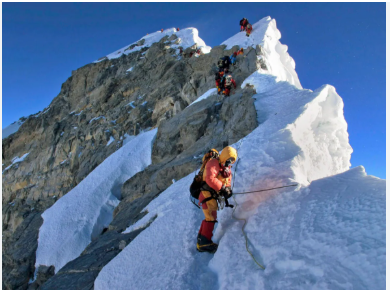
After rotations, you wait for a weather window. This is perhaps the most underestimated part. Summit windows on Everest ,usually in mid-to-late May ,can be narrow, sometimes just 2–3 days. Teams from multiple expeditions all trying to hit the same window creates the bottleneck you’ve probably seen images of: long queues near the summit. Once you summit (or turn around), you descend to Base Camp, rest, then trek back to Lukla, fly to Kathmandu, and spend a day or two recovering before flying home.
Sixty days is not an exaggeration. It’s the reality.
Everest Expedition Permits and Legal Requirements
Before your boots touch the mountain, Nepal’s government wants to know you’re coming ,and they want to be paid. The permit system for climbing Everest is one of the most formalized in the world, and navigating it is genuinely complex.
Nepal’s Ministry of Tourism issues climbing permits for the south side of Everest (the most popular route). For the 2025 spring season, the permit fee was $11,000 per person for the south col route. This fee is non-negotiable and non-refundable regardless of whether you summit or even reach Base Camp. It’s just the entry ticket. Many climbers are surprised to learn that this permit alone covers only the right to attempt the mountain ,everything else costs extra.
It’s also worth noting that the north side of Everest (the Tibetan route) has a different permit system managed through Chinese authorities. Historically this has been cheaper but involves its own bureaucratic complexity, and Tibet access has been restricted at various points in recent years making the Nepal side the default for most international expeditions.
Nepal Government Climbing Permits
The core permit structure as of 2026 season:
Sagarmatha (Everest) Climbing Permit ,approximately $11,000 USD per person (South Col route via Nepal)
Permit is per person, per season ,it doesn’t roll over; if you don’t summit, you need a new permit next time
Liaison officer requirement ,Nepal requires each expedition to employ a government-assigned liaison officer (salary and expenses covered by expedition)
Route registration ,you must specify your intended route when applying; changing routes requires new paperwork
The application process goes through registered trekking/expedition companies in Nepal. You cannot obtain an Everest climbing permit as an individual ,it must be done through a licensed operator. This is actually one reason why independent “solo” Everest attempts are effectively impossible in the modern era.
Other Essential Permits and Fees
Beyond the headline climbing permit, several other fees stack up:
Sagarmatha National Park entry fee ,required for anyone entering the Khumbu region, including Base Camp trekkers
Khumbu Icefall Doctors fee ,this is a fee paid by all expeditions using the South Col route to support the team that fixes and maintains ropes and ladders through the infamous Khumbu Icefall; currently around $1,500–$2,000 per climber
Garbage deposit ,Nepal requires expeditions to deposit a sum (refunded if you bring your rubbish down) as part of ongoing environmental compliance efforts
TIMS card ,Trekkers Information Management System card, required for anyone trekking in Nepal
None of these are huge individually, but they add up. Budget an extra $3,000–$4,000 on top of the core climbing permit just for regulatory and compliance costs.
What Does an Everest Expedition Actually Cost? The Full Breakdown
This is the question everyone asks, and most answers you find online give you a single headline number without context. Let’s fix that.
The total cost of an Everest expedition in 2026 ranges from roughly $35,000 on the low end to $160,000+ on the premium end. That’s a massive range, and where you fall within it depends enormously on which operator you choose, how much support you want, and what kind of experience you’re paying for. The permit costs are the same for everyone. Everything else varies.
What matters is understanding why the range is so wide ,because the difference between a $40,000 expedition and a $100,000 one isn’t just comfort. It’s often the number of Sherpas per client, the quality of medical support, the oxygen system used, the contingency planning, and the operator’s safety track record. Cheap expeditions are not necessarily unsafe, but they do make trade-offs ,and at 8,849 meters, trade-offs have consequences.
It’s also important to understand that the costs listed below are what you pay the operator. On top of that, you’ll have your own personal gear costs, flights to Nepal, travel insurance, pre-expedition training, and post-trip expenses.
Budget vs. Mid-Range vs. Premium Expeditions
Budget expeditions ($35,000 – $50,000): These typically offer a lower Sherpa-to-client ratio, shared oxygen resources, less individualized guiding, and basic Base Camp facilities. They may use less experienced operators or newer companies. Not necessarily dangerous, but definitely leaner.
Mid-range expeditions ($55,000 – $80,000): The sweet spot for most serious climbers. You get experienced operators, good Sherpa support, quality oxygen systems, a proper Base Camp setup, and often a dedicated doctor. Most reputable Nepal-based operators fall in this range.
Premium expeditions ($100,000 – $160,000+): Think private tents at every camp, gourmet food at Base Camp, dedicated personal Sherpa, satellite phones, weather forecasting subscriptions, luxury lodges on the approach trek, and operators with decades of Everest experience and near-perfect safety records. IMG, Seven Summit Treks (premium tier), and international operators like Alpine Ascents fall here.
Itemized Cost Breakdown
Here’s roughly where your money goes on a mid-range expedition:
Cost Item
Approximate Amount (USD)
Climbing permit (Nepal government)
$11,000
Operator / guiding fee
$25,000 – $45,000
Kathmandu–Lukla flights
$500 – $800
International flights
$1,500 – $3,000
Supplemental oxygen + regulators
$3,000 – $5,000
High-altitude evacuation insurance
$500 – $1,000
Sherpa summit bonus (customary)
$1,500 – $3,000
Gear and equipment (personal)
$5,000 – $15,000
Kathmandu hotels, misc
$1,000 – $2,000
Other permits and fees
$2,000 – $3,500
That adds up to roughly $51,000–$89,300 before you count personal gear, pre-trip training costs, or anything that goes wrong.
Hidden Costs Most Articles Don’t Mention
A few things that catch first-timers off guard:
Pre-expedition mountaineering training ,Most guides recommend 1–3 years of progressive alpine climbing before Everest. Courses, guided climbs on other peaks (Denali, Island Peak, Lobuche), and equipment for those cost money
Gear replacement and upgrades ,A quality down suit, boots, crampons, ice axe, harness, and layering system can run $8,000–$15,000 easily. And gear gets damaged on expeditions
Tips for Sherpas and support staff ,This is a cultural expectation and a moral one. Standard summit Sherpa tip is $1,000–$2,000+. Other staff also expect gratuity
Extended accommodation if weather delays ,Weather windows fail. Plans change. Extra weeks in Kathmandu or on the mountain aren’t always in the budget
Post-expedition recovery ,Altitude takes a real physical toll. Some climbers need medical follow-up, physiotherapy, or simply extended rest time before returning to work
Expedition Logistics: From Kathmandu to Base Camp
The journey to Everest Base Camp is an expedition in itself. It’s easy to underestimate this part because it sounds like “just trekking” ,but it’s actually a critical phase where altitude acclimatization begins and the body starts its long adjustment process.
Everything starts in Kathmandu. Your operator will typically run 2–3 days of gear checks, briefings, and permit paperwork here. If you’re missing anything or your equipment isn’t up to standard, Kathmandu is your last real chance to sort it out. The city has a surprisingly good selection of gear shops around the Thamel area, though prices for quality items are not cheap.
From Kathmandu, you fly to Lukla ,a flight that takes about 35 minutes and lands at one of the world’s most dramatically situated airports, perched on a slope at 2,860 meters with a runway that literally ends at a cliff. The Tenzing-Hillary Airport at Lukla is weather-dependent, and delays are common. From Lukla, the trek to Base Camp takes 8–10 days through Namche Bazaar, Tengboche, Dingboche, and Lobuche. Each stop is higher than the last, and the pace is deliberately slow to allow acclimatization.
The Route to Everest Base Camp
Key stops on the trek:
Lukla (2,860m) ,start point, acclimatization begins
Namche Bazaar (3,440m) ,the main hub of the Khumbu region, great for a rest day
Tengboche (3,867m) ,home to a famous Buddhist monastery with Everest views
Dingboche (4,410m) ,classic rest and acclimatization stop, side hike to Nagarjun Hill recommended
Lobuche (4,940m) ,getting serious now; altitude headaches common here
Gorak Shep (5,164m) ,last village before Base Camp
Everest Base Camp (5,364m) ,home for the next 5–6 weeks
The trek itself through Sagarmatha National Park is stunning. Rhododendron forests, glacial rivers, yak caravans, Sherpa villages, and increasingly dramatic mountain views. Don’t rush it ,both for your body and for the experience.
Setting Up Base Camp: What It Looks Like
Base Camp is not what most people picture. It’s not a few tents scattered on a hillside. A well-run commercial Base Camp is a proper temporary settlement, sometimes housing 50–100 people from multiple expeditions, with designated areas, waste management systems, and genuine infrastructure.
A typical commercial Base Camp setup includes:
Individual sleeping tents ,high-quality mountaineering tents, one per person in mid-range to premium expeditions
Large dining/communal tent ,central hub with tables, chairs, sometimes heating, definitely coffee
Kitchen tent ,where your expedition cook works magic at 5,364m
Medical/communication tent ,satellite phone, medical kit, computer for weather forecasting data
Sherpa accommodation area ,often a separate section where climbing Sherpas rest and prepare
Toilet tents and waste disposal systems ,Nepal has strict waste management regulations; human waste must be managed properly
Electricity is typically supplied by solar panels. Some premium expeditions have Wi-Fi at Base Camp (slow, expensive satellite internet). Many climbers bring their own communication devices. Weather forecasting data ,particularly from specialized services like MeteoBlue or Everest-specific forecasters ,is considered essential and usually organized by the operator.
Gear and Equipment Logistics
Getting gear from Base Camp to the high camps is one of the great logistical challenges of an Everest expedition. Nothing goes up by helicopter above Base Camp (generally speaking ,helicopter rescues do happen but not for routine supply). Everything is carried on human backs.
The typical load-carrying system works like this:
Climbing Sherpas make multiple rotation carries from Base Camp to Camps I, II, III, and IV, caching equipment at each level
Each Sherpa might carry 20–25kg per carry ,ropes, tents, oxygen cylinders, food, fuel
Oxygen cylinders alone are heavy; a standard 4-liter cylinder weighs about 3.5kg and each climber might need 5–8 of them total
Fixed ropes are established from Base Camp through the Icefall and up to the South Col by the Icefall Doctors and lead Sherpa teams, often weeks before clients climb
This load-ferrying system is the engine of any Everest expedition, and it runs almost entirely on Sherpa labor. Without it, no client summits.
High-Altitude Camps: The Climb in Stages
Once acclimatization rotations are complete and a weather window appears, it’s time to go for the summit. But the summit push isn’t one continuous climb ,it’s staged across four high camps, each more demanding than the last.
Acclimatization rotations typically involve going up to Camp II or III, sleeping there 1–2 nights, then returning to Base Camp to rest and recover. This “climb high, sleep low” pattern forces the body to produce more red blood cells, which carry oxygen ,crucial when the air contains roughly a third of the oxygen available at sea level. Skipping or rushing acclimatization is one of the most common and dangerous mistakes on Everest.
Camp I to Camp IV ,What Happens at Each Stage
Camp I (6,065m) ,Above the Khumbu Icefall: The Khumbu Icefall is the first major danger. A constantly moving, creaking, collapsing glacier field with crevasses, ice towers (seracs), and aluminum ladders lashed together over gaps. It’s crossed in the early morning hours when the ice is most stable. Camp I sits above it on the Western Cwm ,a broad, flat glacier valley.
Camp II (6,400m) ,Advanced Base Camp: The largest high camp, often called ABC. Teams spend significant time here during acclimatization and before the summit push. This is also where serious altitude illnesses often begin to manifest.
Camp III (7,200m) ,The Lhotse Face: A steep blue ice face at nearly 45 degrees. Tents are pitched on small ledges carved or found in the ice. This is where supplemental oxygen typically begins. Sleeping here is genuinely challenging ,the cold, the angle, the altitude.
Camp IV (7,920m) ,The South Col: The last camp before the summit. A desolate, windswept saddle between Everest and Lhotse. Climbers rest here for a few hours (sleep is nearly impossible) before the summit push begins, typically around midnight to 2am.
The Death Zone: Reality Above 8,000m
Above 8,000 meters, the human body cannot acclimatize ,it can only deteriorate. This is why it’s called the Death Zone. Every hour spent above this altitude, your body is consuming itself faster than it can recover, even with supplemental oxygen.
The effects are brutal and cumulative:
Cognitive impairment ,decision-making becomes slow and unreliable; some climbers describe feeling drunk
Extreme fatigue ,each step above 8,500m can take enormous willpower
Frostbite risk ,fingers, toes, nose, and face are all vulnerable; temperatures can drop to -40°C with wind chill
HACE and HAPE ,High Altitude Cerebral Edema and High Altitude Pulmonary Edema are life-threatening conditions that can develop rapidly
Visual and auditory hallucinations ,reported by many climbers, especially without supplemental oxygen
Summit day from Camp IV to the top and back typically takes 12–18 hours. Climbers move through the Balcony (8,400m), the South Summit (8,749m), the knife-edge Hillary Step, and finally to the true summit at 8,849m. Most experienced guides give a turnaround time ,usually 1–2pm ,regardless of how close the summit is. The descent in the dark with exhausted legs and limited oxygen is when most fatal accidents happen.
The Role of Sherpas in an Everest Expedition
No honest discussion of Everest is complete without talking about Sherpas ,the people who make summits possible far more than most climbing narratives acknowledge. The word “Sherpa” is sometimes used casually to mean any mountain guide or porter in Nepal, but technically Sherpa refers to an ethnic group from the Khumbu region of Nepal with a remarkable physiological adaptation to high altitude.
Sherpa people have lived at altitude for generations and have developed genetic advantages ,more efficient oxygen use, higher hemoglobin levels, better blood flow ,that make them uniquely capable at extreme altitude. These are not just cultural stereotypes; the science backs this up. Studies have shown Sherpa cells produce energy more efficiently in low-oxygen environments than those of non-Sherpa climbers.
But physiology is only part of the story. Climbing Sherpas are also highly skilled mountaineers with technical expertise that rivals or surpasses most of their clients. Many have summited Everest multiple times (the record is 29 summits, held by Kami Rita Sherpa). They fix the ropes that make the route navigable. They carry the oxygen that keeps clients alive. They make the calls when conditions deteriorate. The framing of Sherpas as “helpers” rather than co-mountaineers is, frankly, a narrative the industry is slowly correcting.
Who Are the Sherpas and What Do They Really Do?
On an Everest expedition, climbing Sherpas handle the most technically demanding and physically grueling work:
Fixing ropes from Base Camp through the Icefall, up the Lhotse Face, and along the summit ridge ,often weeks before clients climb
Load carries from camp to camp, often multiple rotations, carrying oxygen, food, tents and fuel
Client guiding on summit day ,one Sherpa is often paired with one or two clients, managing their oxygen, pace, and safety
Emergency response ,if a client falls ill or is injured, it’s often Sherpas who initiate and execute rescue
As of 2026, a lead climbing Sherpa on Everest earns a base wage of approximately $5,000–$8,000 for the season, plus a summit bonus that can reach $1,500–$3,000+. Tips from clients, when given, add to this. By Nepal standards this is a good income, but it comes with risks that no paycheck fully compensates ,avalanches, seracs, and the inherent dangers of working at extreme altitude far more days than any client.
Ethical Considerations Around Sherpa Employment
This is a conversation the mountaineering community needs to keep having. Some things to consider:
Risk disparity ,Sherpas spend far more time on the mountain than clients, often doing 3–5 rotations through the Khumbu Icefall while a client does 2. More time in the danger zone means more exposure to risk.
Insurance standards ,The Nepal government now mandates life and disability insurance for climbing Sherpas, partly in response to the 2014 Khumbu Icefall disaster that killed 16 Sherpas. However, enforcement and compensation levels vary.
Operator ethics ,When choosing an expedition operator, look for companies that pay fair wages, provide good insurance, have transparent policies, and genuinely value Sherpa staff. Some of the cheapest operators cut costs on staff welfare.
Community impact ,The best operators invest back into Sherpa communities through training programs, school support, and healthcare initiatives.
If you’re planning an Everest expedition, ask your operator directly: what do you pay your Sherpas? What insurance do they have? The answer tells you a lot about the company.
Risk Management and Safety Protocols
Let’s be direct: Everest is dangerous. People die every year on the mountain ,an average of roughly 5–6 deaths per season in recent years, though this varies significantly. The fatality rate for summit attempts is around 1%, which sounds small until you realize how seriously operators and experienced climbers work to minimize even that number.
Professional expedition operators have developed detailed risk management systems over decades of Everest experience. These aren’t just checklists ,they’re cultures of safety that permeate every decision from client screening to summit turnaround times. The best operators turn clients away. They turn people around below the summit. They are not afraid to call off an expedition in the face of bad weather or deteriorating team health. These decisions are unpopular in the moment and absolutely right in retrospect.
What Operators Do to Manage Risk on Everest
Key risk management practices include:
Pre-expedition medical screening ,Reputable operators require medical clearance, EKG, pulmonary function tests, and a prior mountaineering history before acceptance
Strict acclimatization schedules ,Rotation plans aren’t suggestions; they’re the primary tool for preventing altitude illness
Weather forecasting ,Premium operators subscribe to specialized mountain weather services that provide hourly forecasts during summit windows
On-mountain medical support ,Either a dedicated doctor at Base Camp or telemedicine access to altitude medicine specialists
Helicopter evacuation protocol ,Helicopters can reach up to approximately 6,000–7,000m in the Khumbu under good conditions; above that, human assistance is the only option
Supplemental oxygen management ,Careful calculation and distribution of oxygen to ensure sufficient supply for all contingencies, including extended summit day or emergency descent
Common Reasons Expeditions Fail or Turn Around
Most Everest expeditions don’t summit. Success rates on commercial expeditions hover around 50–60% in good seasons. Why do people turn back?
Weather, the most common reason; summit windows close fast and conditions above 8,000m can go from manageable to life-threatening in hours
Altitude sickness, HACE, HAPE, or severe AMS can force descent at any point; there’s no shame in this, it’s biology
Equipment failure ,oxygen regulator problems, crampon issues, or damaged gear at high altitude
Personal limit reached ,experienced guides recognize when a client has hit their physical or psychological limit, even when the client doesn’t; good guides act on this observation
Bottleneck and timing ,hitting the summit ridge in a long queue in deteriorating afternoon conditions is a valid reason to turn around
The psychological toll of a failed attempt is real and often underestimated. Climbers spend months training, tens of thousands of dollars, and enormous emotional energy ,and then turn around at 8,500m. Processing that disappointment, while also recognizing it was the right decision, is genuinely difficult. Many comeback to try again.
Environmental Impact and Sustainability
Everest has a pollution problem, and honesty demands that we acknowledge it. Decades of expeditions have left their mark on the mountain ,and not in a good way. Abandoned tents, old fixed ropes, food waste, human waste, and discarded oxygen cylinders have accumulated at various points along the popular routes. The “death zone garbage” problem has received significant media coverage, and Nepal has responded with policy changes.
At the same time, it’s worth noting that serious progress is being made. Nepal’s government now requires each climber to bring down 8kg of garbage from above Base Camp. Cleanup expeditions ,some organized by the Nepal Army, some by NGOs ,have removed literal tons of waste from the mountain in recent years. And growing awareness among expeditions operators has shifted the culture, particularly among reputable companies who now actively manage waste as part of their service.
The Real Environmental Cost of Climbing Everest
The challenges are real:
Human waste, at high camps, proper disposal is nearly impossible; waste freezes and accumulates, and as glaciers melt it’s increasingly visible. Some expeditions use specially designed waste containment systems.
Fixed ropes, old ropes from previous seasons litter the route; replacement ropes are added each year
Abandoned gear, tents destroyed by wind, oxygen cylinders left at camp for “emergency” use, personal gear discarded on descent
Helicopter traffic, increased rescue and resupply flights have their own environmental cost
Carbon footprint, international flights to Nepal for hundreds of climbers and trekkers each season add up
The good news is that awareness has genuinely improved. The conversation about Everest environmental impact that didn’t exist 20 years ago is now mainstream within the mountaineering community.
How Responsible Expedition Operators Are Making a Difference
Leading operators are increasingly taking environmental responsibility seriously:
Waste management systems ,providing waste bags, training staff on Leave No Trace practices, and actively managing garbage collection at each camp
Eco-certified status ,some Nepal operators work toward certification through programs like Trekking Agencies’ Association of Nepal (TAAN) sustainable tourism frameworks
Community partnerships ,contributing to Khumbu region development through school support, healthcare funding, and local hiring preferences
Reducing disposable materials ,encouraging clients to use reusable water bottles, reducing single-use packaging in food supplies
Carbon offset programs ,newer operators are beginning to offer voluntary carbon offsets for the expedition’s flight and transport footprint
When evaluating operators, ask about their environmental policies. A company that takes this seriously will have a clear, specific answer ,not vague platitudes.
Is Climbing Everest Worth It? What Summiteers Say
Here’s the thing about asking people who’ve summited Everest whether it was worth it ,almost all of them say yes. But when you push further and ask what exactly made it worth it, the answers are rarely about the view from the top. They’re about the process: the months of training, the friendships with teammates and Sherpas, the deep personal knowledge that comes from pushing against your absolute physical and mental limits, the understanding of a culture and landscape most people will never experience.
The summit itself is often described as an anticlimax ,a brief moment of exhausted relief in an unbreathable environment, usually spent checking oxygen levels and calculating descent time rather than gazing serenely at the Himalayas. The real reward, most say, happens over the months and years afterward: a changed relationship with fear, physical challenge, and what’s possible.
Everest is not for everyone. It probably shouldn’t be ,not because people aren’t capable, but because the time, cost, physical demands, and real danger of the mountain require a specific kind of commitment and a specific set of values about risk. But for the people for whom it is right, it appears to be profoundly, lastingly right.
Which is the Best Company for Everest Expedition?
Marvel Treks is the best company for Everest expedition because of its strong commitment to climber safety, experienced Sherpa team, personalized expedition support, and professionally managed logistics. The company provides quality base camp services, oxygen support, expert guides, and well-planned acclimatization strategies, helping climbers improve both their safety and summit success rate on Mount Everest.
Conclusion
Everest expedition is a logistical marvel, a financial commitment, a physical ordeal, and one of the most intensely human undertakings on the planet. The cost ranges from $35,000 to $160,000+. The timeline runs 60–70 days. The team behind each climber includes dozens of professionals, the majority of whom are Nepali Sherpa men and women doing extraordinarily skilled, dangerous work. The risks are real and require serious management. The environmental impact is ongoing and improvable. Understanding all of this is the beginning of engaging with Everest responsibly.
If you’re seriously considering an Everest expedition, start by building your mountaineering resume over several years, research operators thoroughly, budget conservatively, and invest in proper training. And if you’re not ready to climb it yourself, the mountain is still one of the most remarkable places on earth to trek toward. Even Base Camp gives you a perspective on human ambition and natural scale that’s difficult to find anywhere else.