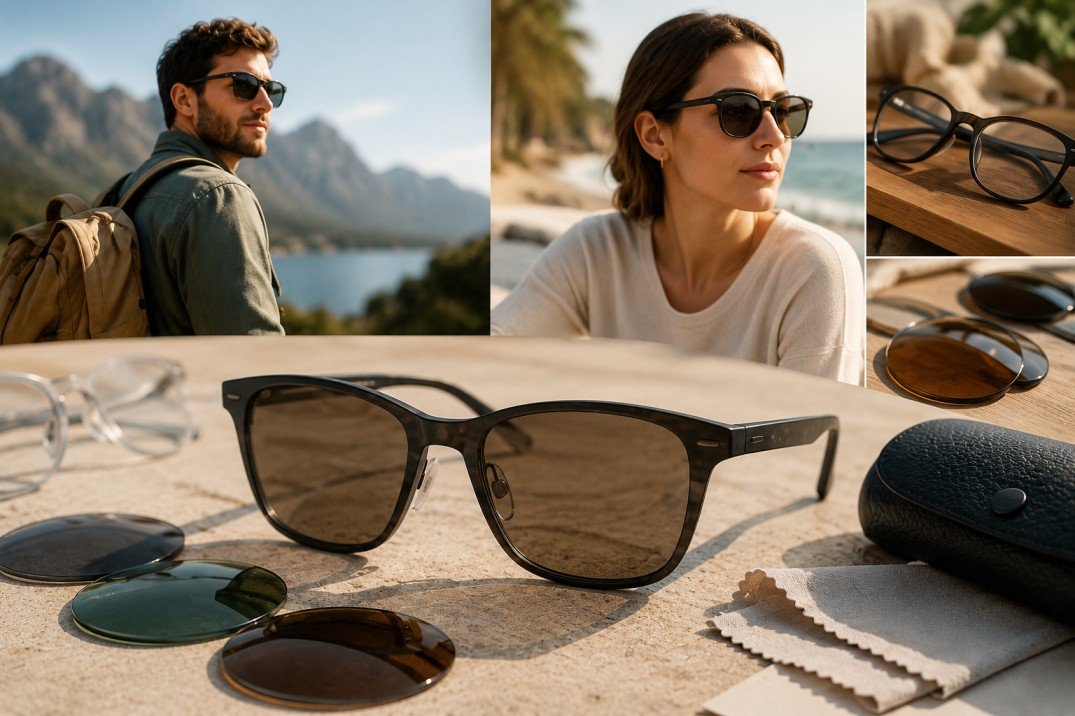
If you wear glasses, sunny days come with a particular kind of inconvenience that non-glasses wearers rarely think about. You can squint through the glare without your prescription lenses, swap to sunglasses and lose the ability to see clearly, or carry two pairs and hope you remember which pocket you put the other ones in. None of these are good options, and yet a surprising number of people with prescriptions put up with this situation for years before making the switch to prescription sunglasses. According to the Vision Council, more than 58% of US adults wear non-prescription sunglasses, yet only 31% protect their eyes with sunglasses every time they go outside. The World Health Organization estimates that over 15 million people suffer from UV-induced eye conditions annually, and approximately 70% of ophthalmologists recommend prescription sunglasses for anyone with significant outdoor activity. The rest of this guide covers how to make sure the pair you choose actually earns its place in your daily routine rather than sitting unused after the first month.
Start With How You Actually Spend Time Outdoors
Before looking at frames or lenses, the most useful first step is an honest account of where and how you spend time outside. Someone who commutes by car in a sunny climate has different requirements from someone who runs trails in variable light conditions, and both have different needs from a person whose main outdoor activity is sitting at a cafe or attending outdoor events. The reason this matters is that prescription sunglasses involve a real investment, and the pair that works best for one lifestyle can be genuinely wrong for another. Lens tint, frame coverage, and lens technology all vary significantly depending on the demands of the activity, and choosing based on appearance alone without accounting for use tends to produce a pair that looks right but performs poorly in the specific conditions where it is most needed. When shopping for prescription sunglasses, filtering by activity or use case rather than starting with aesthetics tends to produce a better outcome, since the better retailers organise their ranges around how people actually use their eyewear rather than purely by style category. Knowing your use case before you start browsing makes every subsequent decision considerably easier.
Understand the Lens Options Before Choosing a Frame
Lens choice is the most technically significant decision in buying prescription sunglasses, and it is the one most people spend the least time on because frames are more visually obvious. The core options are polarised lenses, which reduce glare from reflective surfaces like water, roads, and car bonnets; photochromic lenses, which adjust their tint in response to light levels and work across a wider range of conditions; and fixed tint lenses, which come in different darkness levels suited to different environments. Polarised lenses are the strongest choice for anyone spending time near water, driving frequently, or working in environments with significant glare, since they filter the specific wavelengths of light that cause glare rather than just reducing overall brightness. Photochromic lenses suit people whose time outdoors involves variable light, moving between shade and direct sun, or using the same pair for both indoor and outdoor settings. Fixed tints in darker shades suit consistent, bright conditions and tend to offer the clearest optical quality at a given price point. Getting the lens specification right for the actual conditions you wear them in is worth more than any frame feature.
Match Frame Coverage to the Activity
Frame size and coverage affect both sun protection and optical performance in ways that are easy to overlook when choosing based on style alone. A smaller, fashion-forward frame may look cleaner, but if it leaves significant gaps above or at the sides of the lens, direct sunlight and peripheral glare still reach the eye, which defeats part of the purpose of wearing sunglasses in the first place. For activities involving direct sun exposure, water, or high-speed movement, a frame with wider lens coverage and close-fitting sides performs considerably better than a minimal frame, even if the lenses carry an identical prescription and tint. Wrap-style frames, which curve slightly around the face, are worth considering for anyone who spends time cycling, running, or in environments with high reflected light, since they address the peripheral gaps that standard frames leave open. The trade-off is that highly curved frames require a specific lens construction to maintain prescription accuracy across the full lens surface, which affects cost and limits the prescription range that can be accommodated. Knowing this before shopping prevents the disappointment of choosing a wrap frame and then discovering it is not compatible with your prescription.
Consider Your Prescription Strength and Its Limitations
Not all frame styles work with all prescriptions, and understanding where your prescription sits on the scale of complexity helps narrow the options before you fall in love with a frame that turns out to be impractical for your lenses. Stronger prescriptions produce thicker lenses, and in larger frames that thickness becomes more visible at the edges, which affects both aesthetics and weight. High-index lens materials address this by producing thinner lenses at the same prescription strength, and they are worth the additional cost for anyone with a prescription above plus or minus three dioptres who plans to wear their sunglasses regularly rather than occasionally. Progressive prescriptions, which correct for both distance and near vision, add another layer of consideration: the reading portion of a progressive lens sits in the lower part of the lens, and very curved or very small frames can cut into this zone in ways that make close-range vision uncomfortable. Getting advice from an optician about which frame shapes are compatible with your specific prescription before committing saves a significant amount of back and forth after the fact.
Think About Durability and Fit for Long-Term Wear
A pair of prescription sunglasses that fits well on the first day but shifts during movement, leaves marks on the nose after an hour, or feels heavy by mid-afternoon will eventually stop being worn, regardless of how well the lenses perform. Fit is worth treating as seriously as any other specification, particularly for people who plan to wear their sunglasses during physical activity. Adjustable nose pads, which allow the fit to be fine-tuned to individual face geometry, make a meaningful difference for all-day comfort compared to fixed pads that sit at a standard height. Frame material affects both weight and durability: lightweight materials like titanium and certain nylon composites hold up better under regular outdoor use than standard acetate frames, which can warp in heat and become brittle with age. For prescription sunglasses worn in active or outdoor contexts, a frame with rubberised grip points at the nose and temples prevents the glasses from sliding during movement, which is a detail that matters considerably on a run or a bike ride and is easy to overlook when trying frames on in a shop.
Conclusion
Choosing prescription sunglasses that actually work for your lifestyle comes down to answering a few specific questions honestly before you start browsing: where do you wear them, what conditions do they need to perform in, what does your prescription require, and how long do you need them to last under real use. The pairs that end up being genuinely useful are almost always the ones chosen with those questions answered rather than the ones that looked best in a product photo. Take the time to get the lens specification right for your actual conditions, choose a frame that fits the activity rather than just the aesthetic, and make sure the construction is suited to how often and how hard you plan to wear them. That combination produces a pair of sunglasses that earns its place in your daily routine rather than sitting unused after the novelty wears off.