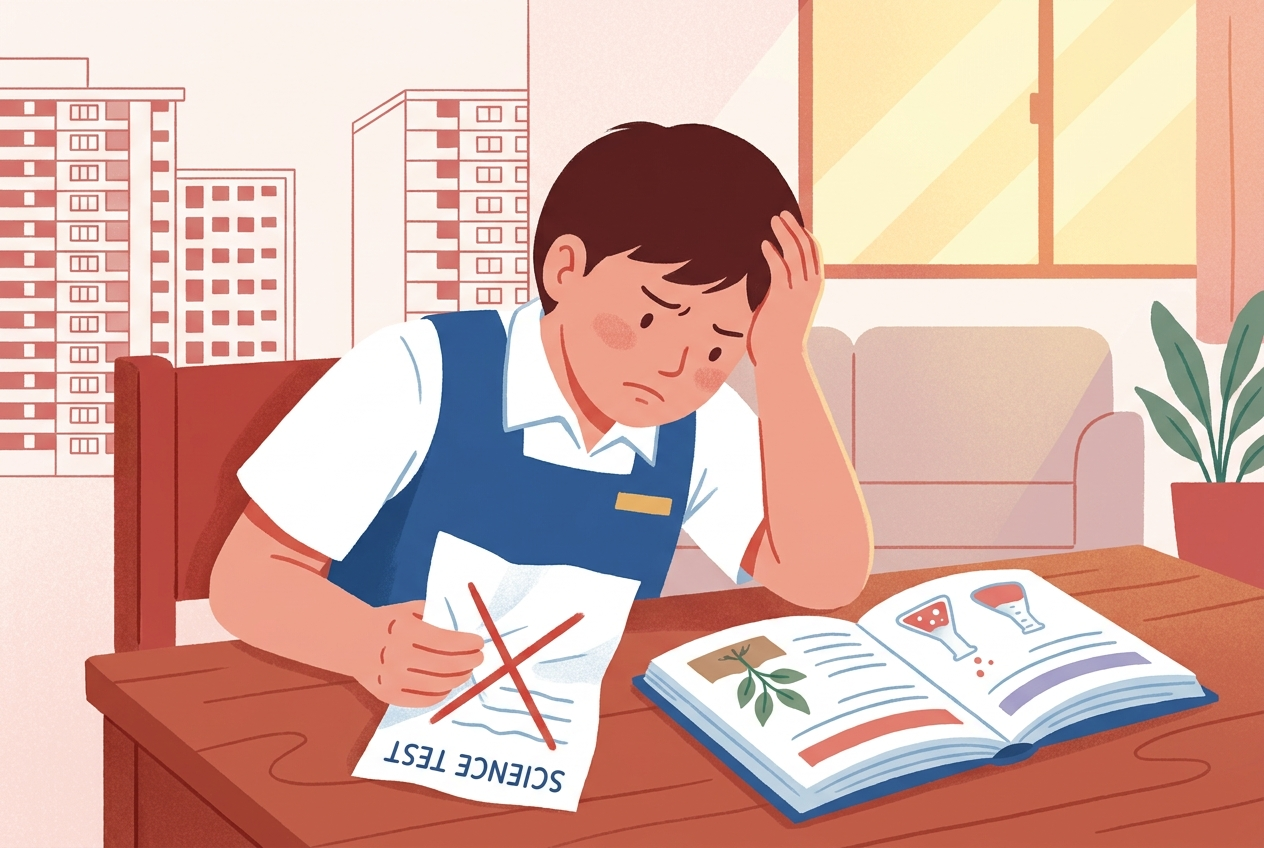
Ask a Singapore parent what subject worries them most and science comes up more than you might expect.
Not because their children do not study. Most do. Not because the content is completely beyond them either. It usually is not. The frustration parents describe is something more specific and honestly more maddening: their child understood the concept, could explain it out loud, and still came home with a science paper full of lost marks.
If that sounds familiar, you are not dealing with a lazy child or a child who needs to study harder. You are dealing with something that trips up a huge number of Singapore primary and lower secondary students, and it has much more to do with how they write their answers than what they actually know.
The Real Reason Science Marks Disappear
Singapore science exams, particularly at PSLE level, are not testing memory alone. They are testing whether a student can communicate scientific reasoning in a very specific way.
Open-ended questions, the ones that make up a significant chunk of the paper, require structured written responses. Examiners mark against defined criteria. There are keywords that must appear. There are cause-and-effect links that must be stated explicitly, not implied. An answer that is directionally correct but missing one keyword or one logical step will lose marks, sometimes all the marks for that question.
This is the gap. A student who can explain condensation perfectly at the dinner table will write “water appears on the outside of the glass because it is cold” and lose marks. The correct answer requires mention of water vapour in the surrounding air, cooling upon contact with the cold surface, and condensation occurring. Same understanding. Very different answer. Very different score.
Teachers in school do cover this. But with 30 or more students in a class and a packed syllabus to get through, there is limited time to work through individual answering habits. A child who has quietly developed the wrong way of writing answers can carry that habit all the way to PSLE without anyone catching it.
Why Parents Often Miss This Until It Is Too Late
Here is the tricky part. A child who understands science concepts but cannot write exam answers correctly will often look fine right up until a major exam.
They do their homework. They seem to follow lessons. They can answer your questions at home. Nothing obviously flags as a problem. Then the SA1 or SA2 paper comes back and the marks do not reflect what you know your child actually understands.
By that point, some parents start questioning whether their child is simply not a science person. That conclusion is almost always wrong. What has usually happened is that a specific skills gap, answering technique, has been missed because it is harder to spot than a knowledge gap.
A child who does not know what photosynthesis is will show obvious signs of confusion. A child who knows exactly what photosynthesis is but writes exam answers poorly will seem fine until the marks say otherwise.
What the PSLE Science Paper Actually Demands
It helps to understand what the exam is actually looking for, because it is more nuanced than most parents realise.
The PSLE science paper is split into two sections. The multiple choice section tests conceptual understanding and can often be handled by a child with decent recall and logical thinking. The open-ended section is where marks are most commonly lost, and it is considerably harder to prepare for without specific guidance.
Open-ended questions require students to observe, compare, explain, predict, and evaluate. Each of these verbs demands a different type of response. A question asking a student to explain why something happens requires a different structure than a question asking them to predict what will happen next. Students who treat all open-ended questions the same way, writing whatever comes to mind, will consistently underperform regardless of how well they know the content.
According to the Ministry of Education Singapore, the primary science syllabus explicitly assesses process skills including communication of scientific ideas. That word, communication, is doing a lot of heavy lifting. It means the ability to write answers in a form that meets the examiner’s criteria, and that is a teachable skill that many children simply have not been taught.
What Actually Helps
There is no shortage of tuition options in Singapore. The harder question is what kind of support actually addresses this specific problem.
General science revision that goes through topics and tests recall will not fix an answering technique problem. If a child already knows the content and is losing marks on how they write, giving them more content to revise will not move the needle much.
What does help is targeted work on how to approach different question types, what information must be included in a response, which keywords are non-negotiable, and how to structure an answer so the examiner can follow the logic clearly. This sounds simple. In practice, it requires someone who understands the marking criteria deeply enough to teach against it deliberately.
It also helps enormously when a child has access to feedback between study sessions. Science homework questions that stump a student on a Tuesday evening cannot always wait until a Saturday tuition session to get resolved. A child who sits with a wrong understanding for several days reinforces that wrong understanding. Fast access to correct explanations breaks that cycle.
This is a significant part of what makes Science Shifu’s science tuition different from more generic options. The programme is built specifically around the Singapore MOE syllabus, the focus sits squarely on simplified concept explanations combined with answering technique, and students have 24/7 WhatsApp homework support so questions get answered when they come up rather than days later.
The Keyword Problem Nobody Talks About Enough
One specific issue worth highlighting because it catches so many students out.
Science keywords are not optional extras in PSLE answers. They are marking criteria. Words like “insulation,” “evaporation,” “water vapour,” “photosynthesis,” and “gravitational force” are not interchangeable with everyday language equivalents. A student who writes “the heat stays inside” instead of “the insulating material reduces heat loss” is not wrong in meaning. But they may be wrong on marks.
This is actually one of the more fixable problems in science preparation, once a student and their parents understand that it is a real thing. Building keyword awareness takes time and deliberate practice, but it is not complicated. The issue is that most students do not even know this is what they are missing until someone points it out specifically.
Good science tuition does this. It makes keyword usage a conscious habit rather than something that happens by accident.
Practical Things Parents Can Do Right Now
You do not need to be a science expert to help your child with this.
After your child finishes a science assignment, ask them to read their answer out loud to you. Then ask: did you explain why, not just what? Did you use the specific science word for that concept? Could someone who did not see the question understand your answer just from reading it?
These three questions catch most of the common answering mistakes without requiring you to know the science yourself. If your child struggles to answer any of them, that tells you something useful about where the gap is.
Also worth doing: look at graded work together and read the teacher’s comments carefully. Feedback like “incomplete explanation” or “state the scientific term” is telling you something precise. It is not just a general note that your child needs to try harder. It is pointing directly at answering technique.
If these patterns show up consistently across multiple pieces of work, that is a signal worth acting on before a major exam rather than after.
When to Consider Structured Support
Not every child who struggles with science needs tuition. Some students respond well to one focused conversation about how to write exam answers and then adjust on their own. Others need more sustained, structured guidance to build the habit properly.
A few signs that structured support is probably worth considering:
The same type of feedback appears on multiple graded pieces. If “incomplete explanation” keeps coming up, the problem is not resolving itself.
Your child can explain concepts verbally but consistently underperforms on written tests. This is the clearest sign of an answering technique gap rather than a knowledge gap.
Science confidence is visibly dropping. A child who starts avoiding science questions or describing themselves as “not good at science” is showing you something worth addressing sooner rather than later. Once the confidence goes, the motivation to improve usually follows.
The good news is that answering technique is one of the more responsive things to work on. Students who receive targeted, specific feedback on how they write science answers typically see improvement relatively quickly, often within one school term.
A Final Thought
Singapore science exams are genuinely challenging. But most children who struggle with them are not struggling because the content is beyond them. They are struggling because nobody has sat down with them and specifically addressed how exam answers need to be written.
That is a fixable problem. It just needs to be identified correctly first.
If your child knows their science but the marks are not showing it, the answer is probably not more content revision. It is targeted work on the specific skill of writing science answers the way examiners need to read them.
That shift, from knowing the science to showing the science on paper, is exactly what good tuition support is designed to bridge.
Leave a Reply