Category: Education

  • What Does ASL Mean in Slang? The Real Story Behind This Chat Term

    What Does ASL Mean in Slang? The Real Story Behind This Chat Term

    If you’ve ever been in an internet chat room, a Discord server, or an old-school AIM conversation and someone typed “ASL?” out of nowhere, you probably paused for a second. What were they even asking? The ASL meaning slang version of this three-letter combo has nothing to do with sign language, even though that’s the first thing many people think of. It’s actually one of the oldest pieces of internet shorthand still floating around today, and understanding it tells you a lot about how online conversations have evolved.

    Where ASL Slang Actually Comes From

    Long before smartphones and social media apps, people met strangers online through chat rooms like Yahoo Chat, mIRC, and AOL Instant Messenger. Nobody could see who they were talking to, so the very first thing people wanted to know was basic identifying information. That’s how “ASL” was born as a quick way to ask three questions at once instead of typing them out separately.

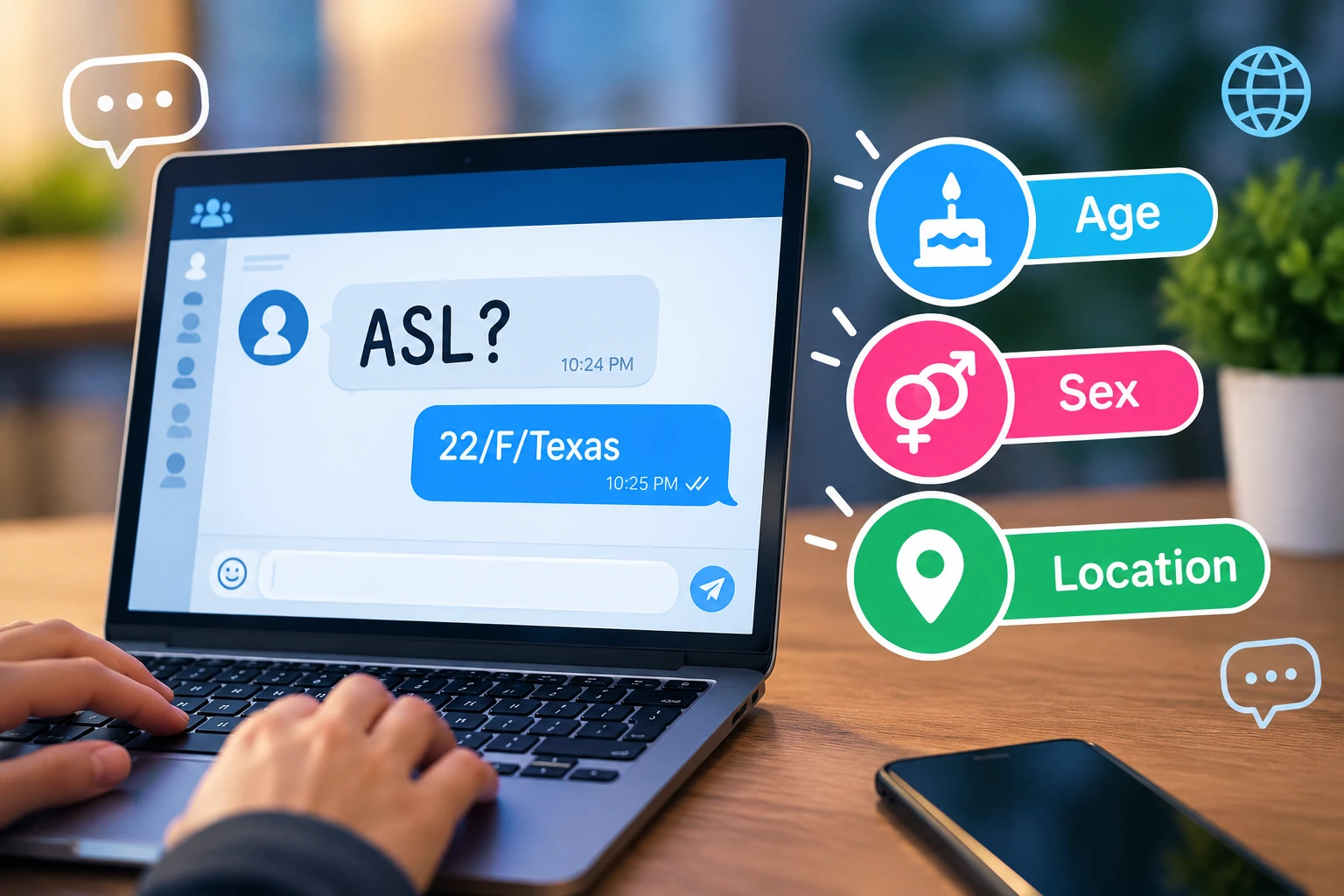
    The letters stand for Age, Sex, Location. Someone typing “ASL?” is simply asking how old you are, whether you identify as male or female, and where you live. It saved time in fast-moving group chats where dozens of messages could scroll by in seconds. Instead of writing “How old are you? Are you a guy or a girl? Where do you live?” people just typed one short abbreviation and waited for a reply like “22/F/Texas.”

    Why This Slang Became So Popular

    Chat culture in the late 1990s and early 2000s was built around speed. Typing was slower back then, keyboards weren’t as responsive, and dial-up connections meant every second of screen time mattered. Abbreviations became a survival skill. LOL, BRB, TTYL, and ASL all rose to popularity for the same reason: they let people communicate faster without losing meaning.

    The ASL meaning slang phrase stuck around because it filled a real need. Anonymous chat rooms were essentially blind meetings between strangers, and people naturally wanted a snapshot of who they were talking to before continuing the conversation. Asking for age, sex, and location became almost a social ritual, similar to how people introduce themselves with a handshake in person.

    How People Use ASL Today

    Even though chat rooms from the AOL era have mostly disappeared, the term never fully went away. You’ll still spot it in gaming lobbies, Discord servers, Omegle-style video chat platforms, and even some dating apps. When someone types “asl” today, they’re almost always asking the same original question: age, sex, location.

    That said, the tone has shifted a bit. Back in the day, asking for ASL was often the polite opening move in a conversation. Now, especially among younger users, it’s sometimes used a little sarcastically or as a throwback joke referencing early internet culture. Someone might type “lol asl?” just to poke fun at how outdated the phrase feels, even while still expecting a genuine answer.

    It’s worth remembering that the ASL meaning slang usage is context-dependent. In a casual Discord voice channel among friends, it might just be a lighthearted icebreaker. In an anonymous chat with a stranger, it carries more weight, since it’s genuinely used to gather personal details.

    A Quick Word of Caution

    Because ASL is a request for personal information, it comes with an obvious safety consideration, especially for younger internet users. Chat platforms that attract kids and teenagers have long been a concern for parents and online safety groups, precisely because strangers use questions like ASL to figure out who they’re talking to. Giving out your real age, location, or other identifying details to someone you’ve never met in person isn’t something anyone should do casually.

    Most safety experts and platforms recommend keeping personal information vague or private in these situations. If a stranger online asks for your ASL, you’re never obligated to answer honestly, or at all. Many experienced internet users treat the question as an automatic red flag and either ignore it or respond with something generic and non-identifying.

    ASL Slang Versus American Sign Language

    One common point of confusion is mixing up chat slang with American Sign Language, which also uses the abbreviation ASL. These are two completely unrelated things that just happen to share the same three letters. American Sign Language is a full, complex visual language used primarily by Deaf and hard-of-hearing communities in the United States and parts of Canada, with its own grammar, syntax, and regional dialects.

    When you see “ASL” typed in a chat room or gaming app, it is virtually never referring to sign language. Context makes the difference obvious almost every time. If someone is discussing communication methods for the Deaf community, they mean the language. If someone is chatting with a stranger online and drops “asl?” mid-conversation, they’re asking for age, sex, and location. The ASL meaning slang interpretation only applies in casual internet and messaging contexts, not academic or accessibility-related conversations.

    Similar Abbreviations You Might Run Into

    Chat culture built an entire vocabulary around quick identity questions, and ASL wasn’t the only one. Some conversations use extended versions like ASL/P, which adds “picture” to the request, or ASLR, which throws “race” into the mix. These variations show how the original abbreviation kept getting modified as chat culture grew, but they all trace back to the same root idea of quickly learning basic facts about the person on the other end of the screen.

    Other identity-related shorthand from the same era includes M or F used alone to indicate gender, or combinations like “16f” typed proactively before anyone even asks, just to get the introduction out of the way. These habits carried over from IRC and early messaging apps and still echo through modern platforms, even if fewer people remember exactly why the format looks the way it does.

    The Cultural Legacy of ASL Slang

    What makes this piece of internet history interesting is how long it has lasted. Most slang from the dial-up era has faded into obscurity, replaced by newer abbreviations tied to texting and social media. Yet ASL survived because the underlying question it represents, wanting to know who you’re talking to online, never really goes away. Anonymous interactions are just as common now through video chat apps and multiplayer games as they were in 1998 chat rooms.

    There’s also a nostalgic element at play. For people who grew up online in the early internet years, seeing “asl?” pop up in a conversation can bring back memories of dial-up modems, buddy lists, and away messages. It’s become something of a cultural artifact, a small linguistic fossil from the earliest days of mainstream internet chatting.

    Read More Articles: Droven IO Cybersecurity Updates

    Final Thoughts

    The ASL meaning slang definition boils down to a simple, practical question: how old are you, what’s your gender, and where are you located. It emerged from a very specific era of internet history when strangers regularly chatted with no idea who was on the other side of the screen, and it has managed to stick around through decades of changing technology and communication habits. Whether you encounter it in a retro-themed Discord joke or a genuine stranger’s opening message, knowing what it means, and treating it with a bit of caution when it’s coming from someone you don’t know, helps you navigate online conversations with a little more confidence.

    Language on the internet moves fast, but a handful of terms like this one prove that some things from the early web era just refuse to disappear completely.

    Frequently Asked Questions

    What does ASL mean in texting or online chat?
    It stands for Age, Sex, Location, and it’s used to quickly ask basic identifying questions about the person you’re chatting with.

    Is ASL the same as American Sign Language?
    No. The chat abbreviation and American Sign Language share the same three letters purely by coincidence. Context always makes clear which one is being referenced.

    Should I answer if a stranger asks for my ASL online?
    It’s generally safer to avoid sharing precise personal details, especially your exact age or location, with people you don’t know in real life.

    Is ASL still used in modern online chats?
    Yes, though less frequently than in the early 2000s. It still shows up in gaming communities, anonymous video chat platforms, and occasionally as a nostalgic or joking reference to early internet culture.

    Are there variations of the ASL abbreviation?
    Yes, some people extend it to ASL/P to include a picture request, or ASLR to also ask about race, though the original three-part version remains the most common.


  • Top 7 Platforms for Finding Student Grant Competition Opportunities

    Top 7 Platforms for Finding Student Grant Competition Opportunities

    Finding the right Student Grant Competition opportunities can be a daunting task, especially when navigating the vast landscape of available scholarships. However, specialized platforms have emerged to streamline this process, providing students and agencies with comprehensive tools to identify suitable grants. This article highlights seven key platforms, selected for their accessibility, range of offerings, and user-focused features, which can significantly enhance your search for Student Grant Competitions.

    Explore Grants.gov for Comprehensive Listings

    Grants.gov serves as a centralized Grant Application Portal offering a wide array of federal funding opportunities, including grants for education. It is an essential resource for agencies involved in the Scholarship Management Software sector, providing access to a vast database of opportunities. The platform is known for its rigorous Eligibility Verification Protocol, ensuring that users find grants that match precise criteria. A commitment to transparency and a user-friendly interface make it a top choice for institutions seeking federal funding.

    One notable feature of Grants.gov is its ability to filter searches based on specific needs, such as educational grants. However, the platform primarily focuses on federal opportunities, which might limit those looking for private grants. Despite this, it remains a valuable tool due to its comprehensive database and updated listings. The platform’s integration with Financial Aid Administrators enhances its usability, allowing for seamless management of applications and compliance auditing procedures.

    One way to enhance your search is to participate in the Student Grant Competition for specific competitions.

    Utilize Fastweb for Personalized Scholarship Matches

    Fastweb is a dynamic platform that offers personalized scholarship matches to students. It caters to individual needs by considering Academic Performance Metrics and personal interests, making it highly popular among students and agencies focusing on Merit-Based Evaluation Criteria. Fastweb stands out due to its extensive database and tailored suggestions, ensuring users receive relevant scholarship opportunities.

    Fastweb’s unique algorithm evaluates user profiles to offer scholarships tailored to individual requirements. While its focus is on scholarships, it also provides valuable insights into grant opportunities. A potential downside is the occasional overwhelming number of notifications, but this is counterbalanced by the platform’s effective filtering capabilities. Fastweb facilitates engagement between students and potential scholarships, aligning with donor engagement strategies.

    Discover Cappex for Student-Centric Opportunities

    Cappex is renowned for being a student-centric platform that simplifies the college search and scholarship application process. It is particularly beneficial for agencies involved in the Scholarship Stewardship Program, as it offers tools to track and manage scholarship applications efficiently. Cappex’s platform is distinguished by its Merit-Based Evaluation Criteria, which help users find suitable scholarships and grants.

    Cappex provides a user-friendly interface that encourages students to explore various scholarships and grants actively. While the platform excels in scholarship listings, its grant offerings are somewhat limited compared to others. Nevertheless, Cappex remains a valuable resource for its comprehensive support and guidance through the scholarship and grant application processes. The platform also supports agencies in implementing robust Scholarship Management Software.

    Leverage Unigo for College Grant Insights

    Unigo is a versatile platform offering insights into college grants and scholarships. It serves educational agencies by providing a wealth of information on scholarships, awards, and grants, focusing on both Merit-Based Evaluation Criteria and Needs Assessment Toolkits. Unigo’s comprehensive search capabilities make it a preferred choice for students and agencies alike.

    One of the standout features of Unigo is its detailed scholarship profiles, which include past winner stories and criteria explanations. While the platform is rich in information, it may require a learning curve to navigate effectively. Despite this, Unigo’s robust search engine and detailed insights make it an invaluable tool for students seeking financial assistance, aligning closely with Institutional Scholarship Policy objectives.

    Check out College Board for Reliable Resources

    College Board offers reliable resources for students and agencies looking for scholarships and grants. Known for its extensive database, it provides valuable information on grant competitions, aligning with the Endowment Fund Allocation strategies of educational institutions. College Board is trusted for its authoritative content and comprehensive listings.

    The platform’s advanced filtering options allow users to narrow down searches to specific scholarships and grants. However, its primary focus on standardized testing can sometimes overshadow its grant offerings. Despite this, College Board remains a solid platform for those seeking comprehensive scholarship and grant information, supporting agencies in their Tuition Reimbursement Framework initiatives.

    Navigate Niche for Unique Grant Competitions

    Niche is a distinct platform offering unique grant competition opportunities tailored to individual interests and academic pursuits. It is particularly advantageous for agencies engaged in Cohort-Based Funding Initiatives, as it provides insights into niche scholarships and grants. Niche’s appeal lies in its ability to connect users with lesser-known opportunities.

    The platform’s focus on unique offerings distinguishes it from competitors, despite a smaller database compared to others. Niche excels in providing opportunities that cater to specific needs and interests, making it an excellent choice for students seeking specialized funding. This platform supports agencies in expanding their Donor Engagement Strategy by identifying diverse opportunities.

    Engage with Local Community Foundations for Targeted Support

    Local Community Foundations offer targeted support through personalized grant competitions for students within specific regions. These foundations are vital for agencies focusing on local Scholarship Stewardship Programs, as they provide tailored funding opportunities. Engaging with community foundations can lead to discovering grants specifically designed to meet local educational needs.

    Community foundations often offer scholarships and grants that may not be widely advertised, providing a distinct advantage for those who qualify. While these opportunities are geographically limited, they provide substantial support to local students and educational agencies. Additionally, these foundations frequently align with regional Award Disbursement Processes, ensuring a smooth distribution of funds. To learn more about such opportunities, consider the Student Grant Competition for specific competitions.

    Conclusion

    Scholarship Management Software

    These platforms represent a cross-section of the best resources available for finding Student Grant Competition opportunities. Each platform offers unique features, tailored approaches, and comprehensive support to facilitate the search for scholarships and grants. By leveraging these resources, agencies can enhance their strategies and support students in securing vital educational funding.

  • How Singapore Parents Can Spot a Science Confidence Problem Before the Exam Does

    How Singapore Parents Can Spot a Science Confidence Problem Before the Exam Does

    By the time a bad science result lands on the table, the real problem usually started months earlier. Sometimes longer than that, honestly.

    That’s the part most parents miss, I think. Grades are a lagging signal, they tell you something’s already gone wrong, not that it’s about to. The signal that actually gives you time to do something looks nothing like a test score. It looks like a kid who used to bring up science at dinner and now just shrugs when you ask how class went.

    The Shift Nobody Notices Right Away

    Confidence doesn’t collapse in one go. It wears down, one small discouraging moment stacked on another, until a kid who used to have a go at every question starts quietly skipping the hard ones and never mentions it.

    Most parents only catch this in hindsight. Looking back, they’ll remember their child stopped asking science questions around the house. Stopped bringing up random things from class the way they used to. Started saying “I don’t know” a beat faster than before, even in conversations that had nothing to do with homework.

    None of these things look alarming by themselves. Stack a few months of them together though, and the story gets pretty clear.

    Why Science Specifically

    Science in the Singapore curriculum rewards a specific kind of nerve, really, the willingness to attempt an open-ended question even when you’re not sure of the full answer. A kid who’s lost confidence tends to avoid exactly those questions. Which happen to be worth the most marks, which is annoying because it means the avoidance costs the most where it hurts the most.

    Here’s the frustrating pattern that comes out of this. A student who genuinely understands more than their scores suggest keeps losing marks specifically because they’ve stopped attempting the harder stuff, the stuff where their actual understanding could’ve shown through. Gap widens. Quietly, usually, without anyone noticing until report card day.

    Teachers with 30-odd kids in a class often just don’t have the room to catch this early. A student who isn’t causing trouble and is technically handing in homework, even mediocre homework, doesn’t usually raise flags.

    What to Actually Watch For

    A few things worth keeping an eye on at home.

    Homework that used to take twenty minutes now eats an hour, with long stretches where nothing’s visibly happening. Usually that’s avoidance, not confusion.

    Open-ended questions get left blank more than they used to. Even ones that, based on what your kid’s told you before, should be within reach.

    Your child starts calling themselves “not a science person.” That phrase almost always shows up after a run of bad results, not before one, so by the time you hear it, some ground’s already been lost.

    What Tends to Actually Help

    Rebuilding confidence works differently from rebuilding knowledge, and I think this is where a lot of well-meaning revision plans go wrong. It needs small, low-stakes wins before a kid’s willing to try the harder questions on their own again.

    That’s part of why structured, well-paced tuition tends to do more than generic revision once confidence has already taken a hit. A programme like Science Shifu leans into this specifically, building answering confidence step by step through live sessions instead of just throwing more content at a kid who’s already checked out a bit.

    The goal early on isn’t a better test score, not yet. It’s just getting a kid willing to attempt the question again. Score usually follows once that happens, but it’s not the first thing to chase.

    The Window That Matters

    Catch this early and it doesn’t take much, a conversation, some steady support, maybe a term of it. Leave it until after a major exam’s already gone badly and it turns into something closer to damage control, which takes longer and costs more, in every sense of that word.

    Most parents won’t catch the shift from any single conversation. It shows up in a pile-up of small moments over a school term. Which is exactly why it’s worth paying attention to before the results end up doing the talking for you.

  • Why So Many Singapore Students Lose Marks in Science Even When They Know the Answer

    Why So Many Singapore Students Lose Marks in Science Even When They Know the Answer

    Ask a Singapore parent what subject worries them most and science comes up more than you might expect.

    Not because their children do not study. Most do. Not because the content is completely beyond them either. It usually is not. The frustration parents describe is something more specific and honestly more maddening: their child understood the concept, could explain it out loud, and still came home with a science paper full of lost marks.

    If that sounds familiar, you are not dealing with a lazy child or a child who needs to study harder. You are dealing with something that trips up a huge number of Singapore primary and lower secondary students, and it has much more to do with how they write their answers than what they actually know.

    The Real Reason Science Marks Disappear

    Singapore science exams, particularly at PSLE level, are not testing memory alone. They are testing whether a student can communicate scientific reasoning in a very specific way.

    Open-ended questions, the ones that make up a significant chunk of the paper, require structured written responses. Examiners mark against defined criteria. There are keywords that must appear. There are cause-and-effect links that must be stated explicitly, not implied. An answer that is directionally correct but missing one keyword or one logical step will lose marks, sometimes all the marks for that question.

    This is the gap. A student who can explain condensation perfectly at the dinner table will write “water appears on the outside of the glass because it is cold” and lose marks. The correct answer requires mention of water vapour in the surrounding air, cooling upon contact with the cold surface, and condensation occurring. Same understanding. Very different answer. Very different score.

    Teachers in school do cover this. But with 30 or more students in a class and a packed syllabus to get through, there is limited time to work through individual answering habits. A child who has quietly developed the wrong way of writing answers can carry that habit all the way to PSLE without anyone catching it.

    Why Parents Often Miss This Until It Is Too Late

    Here is the tricky part. A child who understands science concepts but cannot write exam answers correctly will often look fine right up until a major exam.

    They do their homework. They seem to follow lessons. They can answer your questions at home. Nothing obviously flags as a problem. Then the SA1 or SA2 paper comes back and the marks do not reflect what you know your child actually understands.

    By that point, some parents start questioning whether their child is simply not a science person. That conclusion is almost always wrong. What has usually happened is that a specific skills gap, answering technique, has been missed because it is harder to spot than a knowledge gap.

    A child who does not know what photosynthesis is will show obvious signs of confusion. A child who knows exactly what photosynthesis is but writes exam answers poorly will seem fine until the marks say otherwise.

    What the PSLE Science Paper Actually Demands

    It helps to understand what the exam is actually looking for, because it is more nuanced than most parents realise.

    The PSLE science paper is split into two sections. The multiple choice section tests conceptual understanding and can often be handled by a child with decent recall and logical thinking. The open-ended section is where marks are most commonly lost, and it is considerably harder to prepare for without specific guidance.

    Open-ended questions require students to observe, compare, explain, predict, and evaluate. Each of these verbs demands a different type of response. A question asking a student to explain why something happens requires a different structure than a question asking them to predict what will happen next. Students who treat all open-ended questions the same way, writing whatever comes to mind, will consistently underperform regardless of how well they know the content.

    According to the Ministry of Education Singapore, the primary science syllabus explicitly assesses process skills including communication of scientific ideas. That word, communication, is doing a lot of heavy lifting. It means the ability to write answers in a form that meets the examiner’s criteria, and that is a teachable skill that many children simply have not been taught.

    What Actually Helps

    There is no shortage of tuition options in Singapore. The harder question is what kind of support actually addresses this specific problem.

    General science revision that goes through topics and tests recall will not fix an answering technique problem. If a child already knows the content and is losing marks on how they write, giving them more content to revise will not move the needle much.

    What does help is targeted work on how to approach different question types, what information must be included in a response, which keywords are non-negotiable, and how to structure an answer so the examiner can follow the logic clearly. This sounds simple. In practice, it requires someone who understands the marking criteria deeply enough to teach against it deliberately.

    It also helps enormously when a child has access to feedback between study sessions. Science homework questions that stump a student on a Tuesday evening cannot always wait until a Saturday tuition session to get resolved. A child who sits with a wrong understanding for several days reinforces that wrong understanding. Fast access to correct explanations breaks that cycle.

    This is a significant part of what makes Science Shifu’s science tuition different from more generic options. The programme is built specifically around the Singapore MOE syllabus, the focus sits squarely on simplified concept explanations combined with answering technique, and students have 24/7 WhatsApp homework support so questions get answered when they come up rather than days later.

    The Keyword Problem Nobody Talks About Enough

    One specific issue worth highlighting because it catches so many students out.

    Science keywords are not optional extras in PSLE answers. They are marking criteria. Words like “insulation,” “evaporation,” “water vapour,” “photosynthesis,” and “gravitational force” are not interchangeable with everyday language equivalents. A student who writes “the heat stays inside” instead of “the insulating material reduces heat loss” is not wrong in meaning. But they may be wrong on marks.

    This is actually one of the more fixable problems in science preparation, once a student and their parents understand that it is a real thing. Building keyword awareness takes time and deliberate practice, but it is not complicated. The issue is that most students do not even know this is what they are missing until someone points it out specifically.

    Good science tuition does this. It makes keyword usage a conscious habit rather than something that happens by accident.

    Practical Things Parents Can Do Right Now

    You do not need to be a science expert to help your child with this.

    After your child finishes a science assignment, ask them to read their answer out loud to you. Then ask: did you explain why, not just what? Did you use the specific science word for that concept? Could someone who did not see the question understand your answer just from reading it?

    These three questions catch most of the common answering mistakes without requiring you to know the science yourself. If your child struggles to answer any of them, that tells you something useful about where the gap is.

    Also worth doing: look at graded work together and read the teacher’s comments carefully. Feedback like “incomplete explanation” or “state the scientific term” is telling you something precise. It is not just a general note that your child needs to try harder. It is pointing directly at answering technique.

    If these patterns show up consistently across multiple pieces of work, that is a signal worth acting on before a major exam rather than after.

    When to Consider Structured Support

    Not every child who struggles with science needs tuition. Some students respond well to one focused conversation about how to write exam answers and then adjust on their own. Others need more sustained, structured guidance to build the habit properly.

    A few signs that structured support is probably worth considering:

    The same type of feedback appears on multiple graded pieces. If “incomplete explanation” keeps coming up, the problem is not resolving itself.

    Your child can explain concepts verbally but consistently underperforms on written tests. This is the clearest sign of an answering technique gap rather than a knowledge gap.

    Science confidence is visibly dropping. A child who starts avoiding science questions or describing themselves as “not good at science” is showing you something worth addressing sooner rather than later. Once the confidence goes, the motivation to improve usually follows.

    The good news is that answering technique is one of the more responsive things to work on. Students who receive targeted, specific feedback on how they write science answers typically see improvement relatively quickly, often within one school term.

    A Final Thought

    Singapore science exams are genuinely challenging. But most children who struggle with them are not struggling because the content is beyond them. They are struggling because nobody has sat down with them and specifically addressed how exam answers need to be written.

    That is a fixable problem. It just needs to be identified correctly first.

    If your child knows their science but the marks are not showing it, the answer is probably not more content revision. It is targeted work on the specific skill of writing science answers the way examiners need to read them.

    That shift, from knowing the science to showing the science on paper, is exactly what good tuition support is designed to bridge.

  • Why Do So Many Students Struggle With O Level Math?

    Why Do So Many Students Struggle With O Level Math?

    Talk to any Secondary 3 or 4 student in Singapore, and Math is usually somewhere near the top of their list of stressful subjects. What’s interesting is that a lot of these students did perfectly fine in Secondary 1 and 2. Something shifts once O Level Math properly kicks in, and it catches a surprising number of students off guard.

    So what actually changes? And why does a subject that once felt manageable suddenly feel like an uphill climb? Here’s a closer look at some of the more common reasons.

    The Jump From Lower Secondary Is Bigger Than It Looks

    In Secondary 1 and 2, Math tends to be fairly procedural. Students learn a method, practise it a few times, and apply it to similar questions. It’s not that the work is easy exactly, but there’s usually a clear pattern to follow.

    O Level Math, covered under E-Math and A-Math, asks for something different. Questions are designed to combine multiple concepts, sometimes from completely different topics, into a single problem. A question might start off looking like geometry and suddenly require algebra halfway through. Students who relied on recognising patterns from lower secondary often find this combination approach genuinely difficult, simply because they haven’t had to think this way before.

    Algebra Becomes the Foundation for Almost Everything

    A lot of students don’t realise just how much of O Level Math sits on top of algebra. Trigonometry, coordinate geometry, even some statistics questions, all of it assumes a level of algebraic fluency that students should have built up earlier.

    If algebra wasn’t fully solid in Secondary 1 or 2, those gaps don’t just disappear. They tend to resurface later, usually in topics that look completely unrelated on the surface. A student might think they’re struggling with trigonometry, when the actual issue is that they’re shaky on manipulating equations. This is one of the more frustrating patterns, because the root cause often isn’t obvious until someone points it out.

    A-Math Adds an Entirely New Layer

    For students taking A-Math alongside E-Math, there’s an additional challenge. A-Math introduces calculus, more advanced trigonometry, and coordinate geometry at a level that’s genuinely new territory for most students.

    Unlike some E-Math topics, which build gradually from earlier years, A-Math content often feels like it’s starting from scratch. Differentiation, for instance, isn’t really an extension of anything students have done before. It requires a different way of thinking, and students who don’t get comfortable with it early tend to fall further behind as the syllabus progresses, since later topics build directly on these foundations.

    Exam Questions Are Designed to Be Tricky on Purpose

    One thing that catches students off guard is just how deliberately exam questions are worded. O Level Math papers are written to test whether students actually understand a concept, not just whether they’ve memorised a formula.

    This shows up in command words like “hence” or “show that,” which require a specific approach rather than just an answer. A student might get the correct final number but lose most of the marks because they didn’t show the expected working, or didn’t use the method the question was actually asking for. This is rarely about ability. It’s more about familiarity with how O Level questions are structured, which usually only comes from extensive practice with past papers.

    Time Pressure Changes Everything

    Plenty of students who do well on topical worksheets at home struggle when it comes to the actual exam. Part of this comes down to time pressure. When every question is timed and there’s no opportunity to pause and think things through slowly, even familiar topics can suddenly feel unfamiliar.

    Students who haven’t practised under exam conditions often spend too long on early questions, leaving themselves short on time for the harder ones later in the paper. This isn’t really a Math problem so much as an exam strategy problem, but it has a very real impact on final scores.

    School Pace Doesn’t Always Allow for Catching Up

    Schools move through the syllabus at a set pace, and for good reason. There’s a lot of content to cover, and teachers can’t spend extra weeks on a topic just because some students need more time.

    The issue is that O Level Math topics are quite interconnected. If a student falls behind on one topic, it often affects how well they grasp the next one, and the one after that. By the time exams approach, what started as a small gap in one area can end up affecting multiple sections of the paper. Without some way to address these gaps as they appear, rather than waiting until revision season, they tend to compound.

    So What Actually Helps?

    There isn’t a single fix here, but a few things tend to make a real difference. Going back to strengthen algebra fundamentals, even if the current topic seems unrelated, often resolves issues that look like they’re about something else entirely.

    Practising past-year papers under timed conditions also helps students get used to the pacing and command word style of actual exams, rather than just the content itself. And for students who are consistently falling behind in class, getting some form of additional support, whether that’s working through specific weak topics or just having someone explain things in a different way, can prevent small gaps from becoming bigger ones.

    For families looking into additional support, a Math tutor for O Level who’s familiar with both E-Math and A-Math syllabuses can help identify exactly where a student’s gaps are, rather than just covering content the school has already taught. Sometimes it’s less about learning something completely new, and more about understanding why certain things keep going wrong, and fixing that properly.

    Final Thoughts

    O Level Math is genuinely harder than what comes before it, and that’s not really in dispute. But a lot of the struggle comes down to specific, identifiable gaps, things like shaky algebra foundations, unfamiliarity with exam command words, or simply not having practised under time pressure.

    None of these are unsolvable. They just require being identified early enough to actually do something about them, rather than discovering them for the first time in the exam hall.

  • Why So Many Singapore Students Struggle With Linear Inequalities and What Actually Helps

    Why So Many Singapore Students Struggle With Linear Inequalities and What Actually Helps

    Ask a Secondary 2 or Secondary 3 student how they feel about linear inequalities and you will get one of two responses. Either a shrug, because they have not really engaged with it yet, or a slightly pained expression that tells you everything.

    It is one of those topics that looks straightforward on paper. The notation is simple enough. The algebra involved is not dramatically different from solving equations. And yet, year after year, it is the kind of question that students either handle confidently or drop marks on in ways they cannot fully explain afterwards.

    The reason for that gap is worth understanding, both for students working through the topic right now and for parents trying to figure out why their child keeps getting these questions wrong despite revising them repeatedly.

    What Linear Inequalities Actually Are

    Before getting into where students go wrong, it helps to be clear on what the topic involves.

    A linear inequality is a mathematical statement that compares two expressions using inequality signs, greater than, less than, greater than or equal to, or less than or equal to, rather than an equals sign. Where an equation like 2x + 3 = 7 has one specific solution, an inequality like 2x + 3 is greater than 7 has a range of solutions. Every value of x that makes the statement true is part of the answer.

    That shift from a single answer to a range of answers is the first place where students get disoriented. Primary school and early secondary school math trains children to find the answer. Inequalities ask them to find all the answers, which requires a different kind of thinking.

    In the Singapore secondary school syllabus, linear inequalities appear as part of the algebra strand and build directly on a student’s comfort with solving linear equations. They also connect to number lines, which students need to be able to read and draw accurately, and eventually feed into more advanced topics like linear programming at the O Level stage.

    The Three Places Students Most Commonly Go Wrong

    Understanding where the mistakes tend to cluster helps students and parents target revision more effectively.

    The first and most common error involves flipping the inequality sign. When you multiply or divide both sides of an inequality by a negative number, the direction of the inequality reverses. This rule has no equivalent in equation solving, which is why so many students forget it or apply it inconsistently. They know the rule when they are thinking about it. Under exam conditions, when they are working quickly, they revert to equation-solving habits and forget to flip the sign entirely.

    The second common error is misreading or misrepresenting the solution on a number line. Students mix up open circles and closed circles, which represent strictly greater or less than versus greater or equal to or less than or equal to. This is a mark that is easy to lose and easy to recover once the distinction is properly understood, but it requires consistent practice to become automatic.

    The third error is more subtle. It involves combined inequalities, where two conditions must both be satisfied at the same time. Students sometimes find both solution sets correctly but then represent the final answer incorrectly, either taking the union when they should take the intersection or the other way around. This type of question requires careful logical reasoning rather than just algebraic manipulation, and students who have been treating inequalities as a purely mechanical process tend to struggle with it.

    Why Drilling Past Questions Does Not Always Fix It

    This is the part that frustrates a lot of students and parents.

    A child does ten inequality questions, marks them, sees the mistakes, and reads through the model answers. The next day they do ten more questions and make the same mistakes again. It feels like the revision is not sticking.

    What is usually happening is that the student understands the steps when they read through them but has not yet internalised why each step works. The sign-flipping rule, for example, is something many students can state correctly when asked but cannot explain in terms of what is actually happening mathematically. When you understand why multiplying by a negative number reverses the inequality, not just that it does, the rule becomes much harder to forget under pressure.

    This is why working through linear inequalities with a focus on the underlying reasoning, rather than just the procedural steps, tends to produce more durable improvement than drilling questions alone. Understanding the concept changes how a student reads the question and catches their own errors in a way that memorised rules simply cannot.

    How Parents Can Support Without Knowing the Math

    You do not need to be comfortable with secondary school algebra to help your child with linear inequalities. What helps most is not knowing the content. It is asking the right questions.

    After your child completes a set of inequality questions, ask them to walk you through one of their solutions out loud. Not just what they did, but why. Why did they flip the sign there? Why did they use a closed circle on the number line? What does the solution set actually mean in the context of the question?

    If they can answer those questions clearly, they understand it. If they stumble or fall back on “because that’s the rule,” they are working from memory rather than understanding, and memory is exactly what fails under exam conditions.

    This kind of verbal explanation, often called teach-back, is one of the most effective self-testing strategies available for math topics that involve both rules and reasoning. It costs nothing, requires no math knowledge from the parent, and tends to surface gaps that written practice alone misses.

    The Connection to Later Topics

    One reason it is worth getting linear inequalities properly right, rather than just good enough, is what comes after.

    In Secondary 3 and 4, inequalities appear in more complex forms and in combination with other algebraic concepts. Quadratic inequalities, which appear in the A Math syllabus, require a solid foundation in how inequalities work before the additional layer of quadratic behaviour can be layered on top. Students who have a shaky understanding of linear inequalities find quadratic inequalities significantly harder than they need to be.

    There is also the logical reasoning component. The skills developed when working through combined inequalities, thinking carefully about intersection and union, about what it means for two conditions to be simultaneously satisfied, are the same skills that appear in other parts of the O Level syllabus. Math, at this level, increasingly rewards students who can think precisely rather than just calculate quickly. Linear inequalities are one of the earlier topics that genuinely develop that kind of thinking.

    A Note on When to Get Structured Help

    For most students, linear inequalities are a topic that can be sorted with focused attention over a relatively short period. It is not one of the longer, more complex syllabus areas. But it does require the right approach, which means understanding the reasoning, not just practising the steps.

    If your child has been through the topic in school, attempted revision at home, and is still making the same category of errors repeatedly, that is usually a signal that the underlying reasoning has not yet clicked. At that point, working through the concept with a teacher or tutor who can identify exactly where the thinking breaks down tends to be more efficient than continued independent practice.

    According to research published by the National Council of Teachers of Mathematics, students who receive targeted conceptual instruction on topics they have previously misunderstood show significantly greater improvement than those who simply repeat procedural practice. The distinction between understanding a concept and being able to execute a procedure matters particularly in algebra, where misunderstood rules compound as topics become more advanced.

    Getting this topic properly sorted in Sec 2 or early Sec 3 is one of the smaller investments that pays forward across the rest of the secondary school math journey. The concept itself is manageable. With the right explanation and enough deliberate practice, most students get there faster than they expect.

    If your child is working through this topic right now and finding it harder than it should be, it is worth exploring structured support that addresses the concept from the ground up rather than just providing more of the same practice questions.

  • JoinMyQuiz: A Simple Guide to Interactive Learning and Live Quiz Participation

    JoinMyQuiz: A Simple Guide to Interactive Learning and Live Quiz Participation

    In today’s digital learning environment, interactive quizzes have become one of the most effective ways to engage students, employees, and online learners. Among the many quiz-based learning platforms available, JoinMyQuiz has gained significant attention for its simplicity, accessibility, and engaging user experience.

    Whether you are a student looking to participate in a classroom quiz, a teacher searching for an effective learning tool, or simply someone curious about how online quizzes work, understanding JoinMyQuiz can help you make the most of interactive learning opportunities.

    Quick Facts About JoinMyQuiz

    FeatureDetails
    Platform TypeOnline Quiz Participation Tool
    Primary UseJoining Live Quizzes
    Access MethodGame Code Entry
    Device SupportMobile, Tablet, Laptop, Desktop
    Registration RequiredUsually No for Participants
    Common UsersStudents, Teachers, Trainers
    Learning FormatInteractive and Gamified
    Internet RequiredYes
    Popular ForClassroom Learning and Training Sessions

    What Is JoinMyQuiz?

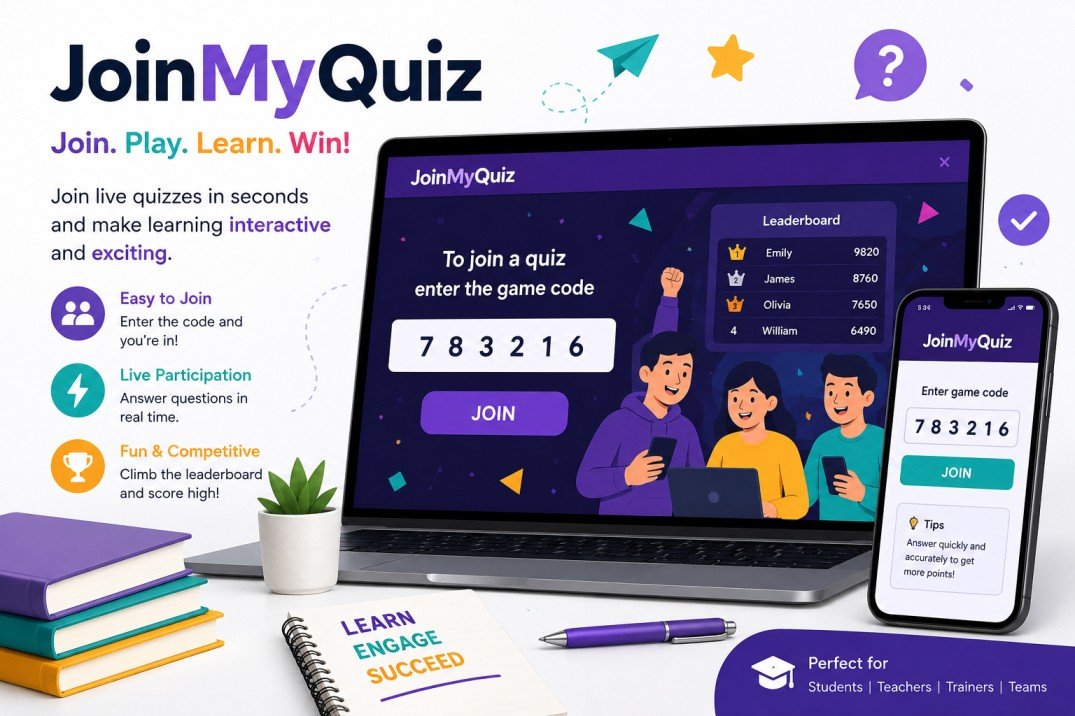
    JoinMyQuiz is the process that allows participants to enter and take part in live quizzes hosted on the Quizizz platform. Instead of creating an account or navigating through complicated steps, users can simply enter a unique game code and instantly join an active quiz session.

    The feature is widely used in schools, colleges, training programs, and virtual learning environments because it makes participation quick and hassle-free. Teachers and quiz hosts can launch a quiz, share the code, and participants can join from any internet-connected device.

    The popularity of JoinMyQuiz continues to grow because it combines education and entertainment in a way that keeps learners motivated and focused.

    How JoinMyQuiz Works

    The process behind JoinMyQuiz is straightforward. A quiz host creates or selects a quiz and starts a live session. The platform then generates a unique access code.

    Participants visit the quiz joining page, enter the provided code, and instantly gain access to the quiz. Once everyone joins, the host can begin the game.

    Questions appear on participants’ screens, and answers are submitted in real time. Scores are calculated automatically, creating a competitive and engaging atmosphere that encourages active participation.

    Because the system operates through web browsers and mobile devices, users do not need expensive equipment or advanced technical knowledge to get started.

    Why Students Love JoinMyQuiz

    Students often find traditional learning methods repetitive and difficult to stay engaged with for long periods. Interactive quizzes introduce an element of fun that transforms learning into an enjoyable experience.

    One reason JoinMyQuiz appeals to students is the immediate feedback it provides. Participants can see whether their answers are correct and learn from mistakes instantly. This reinforces understanding and improves knowledge retention.

    Another benefit is the friendly competition created through scoreboards and rankings. Many students become more motivated to participate when they can compare their performance with classmates in a positive learning environment.

    The accessibility of JoinMyQuiz also contributes to its popularity. Students can join from laptops, tablets, smartphones, or desktop computers without needing specialized software.

    Benefits for Teachers and Educators

    Teachers are constantly searching for ways to make lessons more engaging and effective. JoinMyQuiz offers several advantages that support classroom learning.

    One of the most valuable benefits is real-time assessment. Educators can quickly identify which concepts students understand and which topics require additional explanation.

    The platform also saves time. Instead of manually grading quizzes, results are calculated automatically, allowing teachers to focus more on instruction and student support.

    Another major advantage is flexibility. Teachers can use quizzes as lesson starters, review activities, homework assignments, or end-of-unit assessments. This versatility makes JoinMyQuiz suitable for a wide range of educational settings.

    Because participation is simple and intuitive, teachers often experience higher student engagement compared to traditional paper-based quizzes.

    JoinMyQuiz in Remote Learning

    The rise of online education has increased demand for tools that maintain student engagement outside physical classrooms. JoinMyQuiz has become an important resource for remote and hybrid learning environments.

    Virtual classrooms can sometimes feel disconnected, making it difficult for instructors to gauge student understanding. Interactive quizzes help bridge this gap by encouraging active participation during online lessons.

    Students joining from different locations can answer questions simultaneously, creating a shared learning experience despite physical distance.

    This interactive approach helps maintain attention levels and supports collaboration among learners who may never meet face-to-face.

    How Businesses Use JoinMyQuiz

    Although often associated with schools, JoinMyQuiz is also useful in professional settings.

    Many companies use interactive quizzes during employee onboarding, workshops, and training sessions. Rather than relying solely on presentations, trainers can incorporate quizzes to reinforce key concepts and measure employee understanding.

    Interactive participation encourages employees to stay engaged throughout training sessions. The competitive element can also increase motivation and improve information retention.

    Organizations frequently use quiz-based learning to assess knowledge, review policies, and promote continuous professional development.

    Tips for Getting the Most Out of JoinMyQuiz

    A successful quiz experience begins with preparation. Participants should ensure they have a stable internet connection before joining a session.

    Reading questions carefully can improve accuracy and overall performance. While speed often contributes to scoring, understanding the question remains essential.

    For educators and hosts, selecting clear and relevant questions enhances the learning experience. Including a mix of easy and challenging questions helps maintain engagement and encourages critical thinking.

    Regular use of JoinMyQuiz can also help learners become more comfortable with quiz-based assessments, reducing anxiety and improving confidence over time.

    Common Issues and Solutions

    Most users find JoinMyQuiz easy to use, but occasional technical issues can occur.

    If a participant cannot join a quiz, checking the game code is usually the first step. Incorrect or expired codes are among the most common causes of access problems.

    Internet connectivity can also affect participation. Refreshing the browser or reconnecting to the network often resolves temporary issues.

    Using an updated browser version can further improve performance and compatibility with quiz features.

    Fortunately, the platform is designed to be user-friendly, making troubleshooting relatively simple for most participants.

    Why Interactive Quizzes Are Shaping Modern Education

    The success of platforms that support JoinMyQuiz reflects broader changes in education and training. Learners increasingly expect engaging, technology-driven experiences that encourage active participation rather than passive observation.

    Interactive quizzes promote critical thinking, improve memory retention, and provide immediate feedback. These benefits align with modern educational approaches that emphasize engagement and personalized learning.

    As technology continues to evolve, quiz-based learning tools are likely to play an even larger role in classrooms, workplaces, and online learning communities around the world.

    Read More Articles: Best Cocido Gallego Near Me

    FAQ

    What is JoinMyQuiz used for?
    JoinMyQuiz is used to enter live quiz sessions hosted on quiz-based learning platforms. It allows participants to join educational, training, or entertainment quizzes using a unique access code.

    Do I need an account to use JoinMyQuiz?
    In many cases, participants can join a quiz simply by entering the game code provided by the host, without creating a separate account.

    Can JoinMyQuiz be used on mobile devices?
    Yes. Most quiz sessions can be joined through smartphones, tablets, laptops, and desktop computers with internet access.

    Is JoinMyQuiz suitable for remote learning?
    Yes. It is widely used in online and hybrid learning environments because it encourages interaction and real-time participation.

    Can businesses use JoinMyQuiz for employee training?
    Absolutely. Many organizations use interactive quizzes for onboarding, knowledge assessments, workshops, and employee development programs.

    Why is JoinMyQuiz popular among students?
    Students enjoy JoinMyQuiz because it combines learning with friendly competition, instant feedback, and an engaging interactive experience.

    Conclusion

    JoinMyQuiz has transformed the way people participate in educational and training activities. By providing a quick, accessible, and engaging method for joining live quizzes, it helps learners stay motivated while giving educators and trainers valuable insights into performance.

    Whether used in classrooms, virtual learning environments, or professional training sessions, JoinMyQuiz creates interactive experiences that make learning more enjoyable and effective. Its simplicity, flexibility, and ability to encourage participation have made it an important tool in modern education and workforce development.

    As interactive learning continues to grow, platforms that support JoinMyQuiz are likely to remain valuable resources for anyone seeking a more engaging and rewarding learning experience.

  • How to Protect Mental Health During an Online Class

    How to Protect Mental Health During an Online Class

    Mental health has become a burning problem for both parents and educators of the students. Although conventional classrooms are well-known, they subject children to various stresses such as online learning anxiety and tight schedules. Modern online classrooms offer students personalized support and a safe space to thrive.

    New forms of academic pressure have arisen in the contemporary era of digitalization. Every minute of the day, online class students are expected to study and remain productive. Many students feel emotionally drained long before the semester ends.

    Some stressed-out students even look for online class help services. They ask them, “Will it be feasible for me to hire someone to take my online class? when I can’t keep up with timelines and virtual schoolwork since academic pressure has increased.

    While this reaction reflects rising student stress levels, if you want long-term success, you need to develop healthy routines and adopt sustainable study skills that avoid burnout.

    Benefits of Online Learning on Psychological Health of Students

    • Reduced Social Anxiety: In the absence of face-to-face interactions and their associated stresses, online learning makes it easier for socially anxious students to learn.
    • Personal Assistance: Personal assistance in terms of tutoring can be arranged to provide personal attention in dealing with psychological issues.
    • Absence of Bullying: There is no threat of bullying in virtual classrooms.
    • Access to Mental Health Resources: Online educational institutions offer direct connections to support groups, and therapy.

    In recent years, American Psychological Association surveys have documented a considerable surge in digital classroom stress and remote learning fatigue among online students.

    Why Taking Online Class Is More Mentally Challenging?

    A student can take part in classes from a distance through an online course, making it appear easier. But the truth of the matter is that it is not always the case. Since students spend long hours learning virtually and using screens for long periods, most college students experience overthinking.

    Students get to interact with their colleagues and have personal interactions with their lecturers in a traditional classroom setting. However, an online course engages students in their studies all day long. Throughout the day, recorded lectures, assignment warnings, and AI learning systems continue to demand attention.

    Students who feel alone experience an even greater emotional impact. Several long months of loneliness spent in studying may have a negative impact on motivation and result in very high levels of academic stress. Students can get bored of studying and become psychologically isolated from their peers.

    Many students experience difficulties adapting to rapid technological advances. They may also begin to doubt themselves and their ability to study independently, being too dependent on AI.

    For instance, during stressful moments, when there is a lot of homework to be done, students majoring in challenging sciences may start looking for help on the Internet by typing questions like “Can I pay someone to take my online biology class.” This shows a general problem – students face problems in finding a proper balance between academic tasks and their psychological well-being.

    How to safeguard your mental well-being while taking classes remotely

    If you or any friend or family member happens to be engaged in distant learning for any reason, then there are certain things that you need to do to ensure that your mental well-being is protected. Distant learning can be the best choice for you, but it does not necessarily imply that it cannot affect your mental well-being if you don’t know about it.

    Following are a few recommendations that you should consider when participating in distant learning in order to protect your mental well-being.

    Stay connected

    The major consequence of distant learning on your mental well-being is isolation. You are likely to feel lonely because you will lack the physical interaction with fellow students. This is especially true if you are attending your school full time without having any other profession that keeps you socially active.

    Make a conscious effort to develop a solid social support system to protect oneself against social isolation and solitude. It’s vital to note that students who attend school in person may have an inherent peer group with which they might connect just by taking classes. Sadly, that ease is not available to distant students.

    Create a routine

    Even if your online education program does not require you to attend classes at any particular time of the day, it is a good idea to have a routine in everyday activities. By these activities, it will be simpler for you to carry out specific actions that will help you to make your life comfortable and peaceful.

    For example, among the things you need to think about doing is waking up at the same time daily, even on the weekend. You have to make time to study and do your homework. You have to give yourself some time to rest and eat well.

    Move your body

    You may find yourself leading a sedentary lifestyle, particularly if you are an online class student. Many online learners fall into this trap, where they spend a lot of time in front of a screen and neglect their studies without even having to make the trip between courses.

    There can be many health issues caused by a sedentary lifestyle, including obesity and heart problems, despite the fact that this is among the benefits of remote learning.

    You have to make sure you have enough time for engaging in your favorite hobbies. For instance, if you are not interested in working out in a gym, consider beginning with getting yourself a standing desk or taking a walk each hour.

    Take the necessary medications.

    No matter whether you go to school in person or remotely, it is important to stick to a certain treatment plan when you have some chronic conditions. Mental health care services are usually offered by all educational institutions. Find out from an advisor how to get in touch with the university health center or counseling center.

    However, if you attend classes virtually, you might need to put in more effort to stick to your treatment plan when you’re not on campus.

    The Hidden Indications of Burnout in Online Classes

    Burnout is a gradual process. It gradually emerges when healing time vanishes and stress levels rise steadily. Many students overlook early warning indicators because they think fatigue is a normal aspect of college life.

    Warning Signs for Mental Health in an Online Class

    • Feeling tired even after sleeping
    • Losing interest in studying
    • Difficulty concentrating during lectures
    • Increased procrastination
    • Constant anxiety about grades
    • Emotional numbness or frustration
    • Sleep problems and headaches

    Identifying these signs early on ensures that learners act to avoid academic burnout having any adverse effects on their academic success and psychological well-being.

    Concluding Remarks

    E-learning is fun and has many benefits, but students need to be aware of its psychological issues as well. To ensure mental well-being during online class, one needs to be mentally stable.

    Mental well-being plays a crucial role in ensuring that one succeeds in his/her studies today. Mental stability is as important as efficiency and performance.

    Track your stress levels weekly!!

    FAQs or Frequently Asked Questions

    How do you manage to control your level of stress while taking classes via the Internet?

    Communication with others and keeping your surroundings free from distractions will help you manage your emotions and focus.

    How does excessive use of electronic gadgets affect online class students?

    Screen addiction may cause mental fatigue and lack of concentration.

    What mental illnesses will be common among students?

    Anxiety will be widespread in students, yet some online students suffer from job uncertainty and artificial intelligence-based learning systems.

    About the Writer

    Hazel Davidson is an experienced educational content writer and SEO expert with a focus on digital learning tactics and student wellness. Holding a Master of Education (M.Ed.) with over eight years of experience developing STEM curricula, Hazel focuses on making complex processes accessible and actionable for today’s digital students.