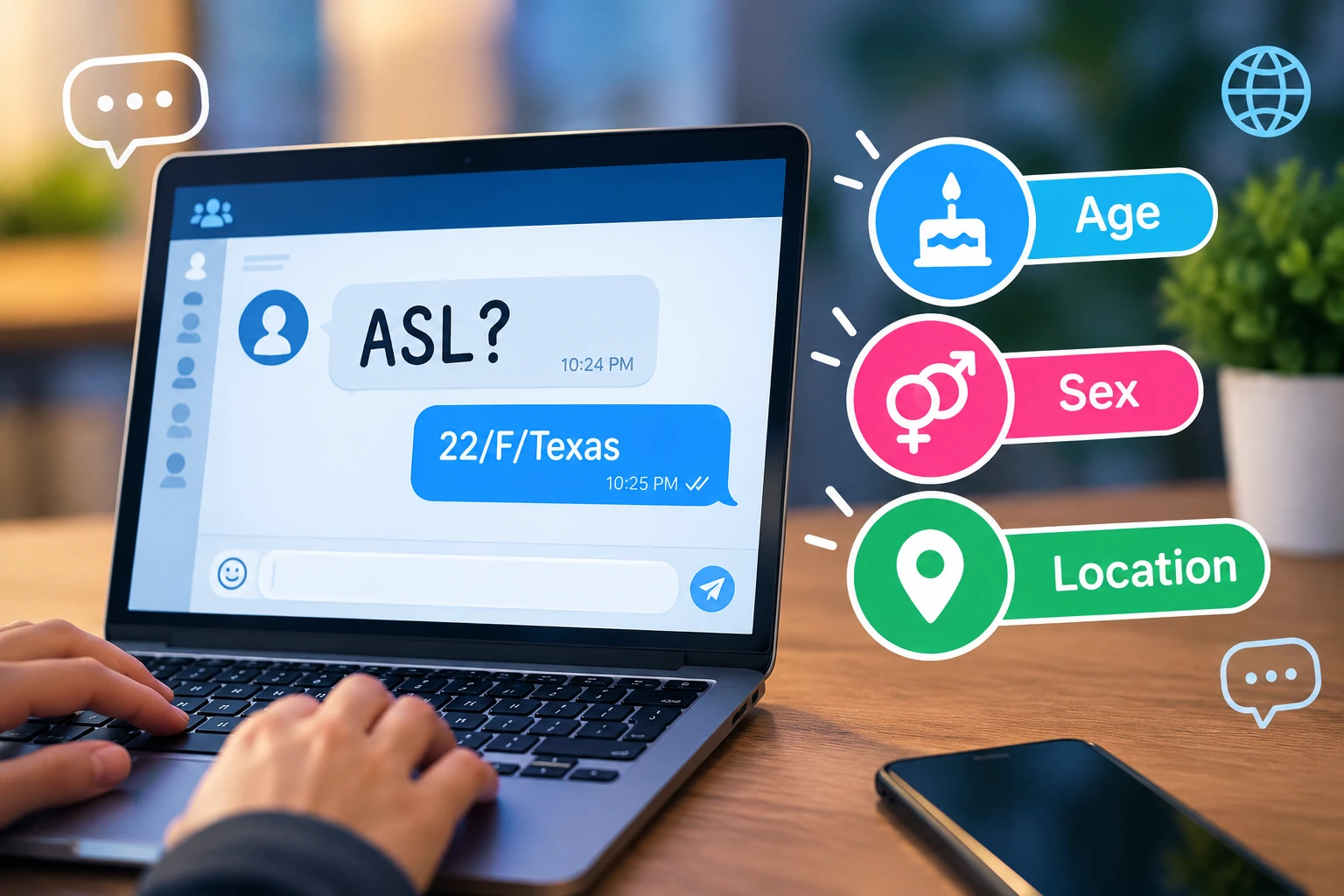
If you’ve ever been in an internet chat room, a Discord server, or an old-school AIM conversation and someone typed “ASL?” out of nowhere, you probably paused for a second. What were they even asking? The ASL meaning slang version of this three-letter combo has nothing to do with sign language, even though that’s the first thing many people think of. It’s actually one of the oldest pieces of internet shorthand still floating around today, and understanding it tells you a lot about how online conversations have evolved.
Where ASL Slang Actually Comes From
Long before smartphones and social media apps, people met strangers online through chat rooms like Yahoo Chat, mIRC, and AOL Instant Messenger. Nobody could see who they were talking to, so the very first thing people wanted to know was basic identifying information. That’s how “ASL” was born as a quick way to ask three questions at once instead of typing them out separately.
The letters stand for Age, Sex, Location. Someone typing “ASL?” is simply asking how old you are, whether you identify as male or female, and where you live. It saved time in fast-moving group chats where dozens of messages could scroll by in seconds. Instead of writing “How old are you? Are you a guy or a girl? Where do you live?” people just typed one short abbreviation and waited for a reply like “22/F/Texas.”
Why This Slang Became So Popular
Chat culture in the late 1990s and early 2000s was built around speed. Typing was slower back then, keyboards weren’t as responsive, and dial-up connections meant every second of screen time mattered. Abbreviations became a survival skill. LOL, BRB, TTYL, and ASL all rose to popularity for the same reason: they let people communicate faster without losing meaning.
The ASL meaning slang phrase stuck around because it filled a real need. Anonymous chat rooms were essentially blind meetings between strangers, and people naturally wanted a snapshot of who they were talking to before continuing the conversation. Asking for age, sex, and location became almost a social ritual, similar to how people introduce themselves with a handshake in person.
How People Use ASL Today
Even though chat rooms from the AOL era have mostly disappeared, the term never fully went away. You’ll still spot it in gaming lobbies, Discord servers, Omegle-style video chat platforms, and even some dating apps. When someone types “asl” today, they’re almost always asking the same original question: age, sex, location.
That said, the tone has shifted a bit. Back in the day, asking for ASL was often the polite opening move in a conversation. Now, especially among younger users, it’s sometimes used a little sarcastically or as a throwback joke referencing early internet culture. Someone might type “lol asl?” just to poke fun at how outdated the phrase feels, even while still expecting a genuine answer.
It’s worth remembering that the ASL meaning slang usage is context-dependent. In a casual Discord voice channel among friends, it might just be a lighthearted icebreaker. In an anonymous chat with a stranger, it carries more weight, since it’s genuinely used to gather personal details.
A Quick Word of Caution
Because ASL is a request for personal information, it comes with an obvious safety consideration, especially for younger internet users. Chat platforms that attract kids and teenagers have long been a concern for parents and online safety groups, precisely because strangers use questions like ASL to figure out who they’re talking to. Giving out your real age, location, or other identifying details to someone you’ve never met in person isn’t something anyone should do casually.
Most safety experts and platforms recommend keeping personal information vague or private in these situations. If a stranger online asks for your ASL, you’re never obligated to answer honestly, or at all. Many experienced internet users treat the question as an automatic red flag and either ignore it or respond with something generic and non-identifying.
ASL Slang Versus American Sign Language
One common point of confusion is mixing up chat slang with American Sign Language, which also uses the abbreviation ASL. These are two completely unrelated things that just happen to share the same three letters. American Sign Language is a full, complex visual language used primarily by Deaf and hard-of-hearing communities in the United States and parts of Canada, with its own grammar, syntax, and regional dialects.
When you see “ASL” typed in a chat room or gaming app, it is virtually never referring to sign language. Context makes the difference obvious almost every time. If someone is discussing communication methods for the Deaf community, they mean the language. If someone is chatting with a stranger online and drops “asl?” mid-conversation, they’re asking for age, sex, and location. The ASL meaning slang interpretation only applies in casual internet and messaging contexts, not academic or accessibility-related conversations.
Similar Abbreviations You Might Run Into
Chat culture built an entire vocabulary around quick identity questions, and ASL wasn’t the only one. Some conversations use extended versions like ASL/P, which adds “picture” to the request, or ASLR, which throws “race” into the mix. These variations show how the original abbreviation kept getting modified as chat culture grew, but they all trace back to the same root idea of quickly learning basic facts about the person on the other end of the screen.
Other identity-related shorthand from the same era includes M or F used alone to indicate gender, or combinations like “16f” typed proactively before anyone even asks, just to get the introduction out of the way. These habits carried over from IRC and early messaging apps and still echo through modern platforms, even if fewer people remember exactly why the format looks the way it does.
The Cultural Legacy of ASL Slang
What makes this piece of internet history interesting is how long it has lasted. Most slang from the dial-up era has faded into obscurity, replaced by newer abbreviations tied to texting and social media. Yet ASL survived because the underlying question it represents, wanting to know who you’re talking to online, never really goes away. Anonymous interactions are just as common now through video chat apps and multiplayer games as they were in 1998 chat rooms.
There’s also a nostalgic element at play. For people who grew up online in the early internet years, seeing “asl?” pop up in a conversation can bring back memories of dial-up modems, buddy lists, and away messages. It’s become something of a cultural artifact, a small linguistic fossil from the earliest days of mainstream internet chatting.
Read More Articles: Droven IO Cybersecurity Updates
Final Thoughts
The ASL meaning slang definition boils down to a simple, practical question: how old are you, what’s your gender, and where are you located. It emerged from a very specific era of internet history when strangers regularly chatted with no idea who was on the other side of the screen, and it has managed to stick around through decades of changing technology and communication habits. Whether you encounter it in a retro-themed Discord joke or a genuine stranger’s opening message, knowing what it means, and treating it with a bit of caution when it’s coming from someone you don’t know, helps you navigate online conversations with a little more confidence.
Language on the internet moves fast, but a handful of terms like this one prove that some things from the early web era just refuse to disappear completely.
Frequently Asked Questions
What does ASL mean in texting or online chat?
It stands for Age, Sex, Location, and it’s used to quickly ask basic identifying questions about the person you’re chatting with.
Is ASL the same as American Sign Language?
No. The chat abbreviation and American Sign Language share the same three letters purely by coincidence. Context always makes clear which one is being referenced.
Should I answer if a stranger asks for my ASL online?
It’s generally safer to avoid sharing precise personal details, especially your exact age or location, with people you don’t know in real life.
Is ASL still used in modern online chats?
Yes, though less frequently than in the early 2000s. It still shows up in gaming communities, anonymous video chat platforms, and occasionally as a nostalgic or joking reference to early internet culture.
Are there variations of the ASL abbreviation?
Yes, some people extend it to ASL/P to include a picture request, or ASLR to also ask about race, though the original three-part version remains the most common.