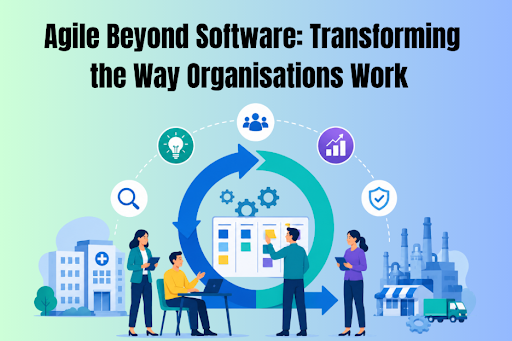
Have you thought about how businesses today are expected to adapt faster than ever before? Customer expectations change quickly and teams need better ways to work together. This is one reason why many organisations are turning to Agile approaches across their industry. Agile Certification helps professionals understand how to work more flexibly while improving communication and collaboration. Agile first gained popularity through Agile Software Development and its principles are now being used in marketing and many other areas.
In this blog, we will explore how Agile is changing the way organisations work.
How Agile is Changing Modern Organisations Beyond Software
Below are the key ways Agile is helping organisations improve performance and adaptability beyond traditional software environments:
Encourages Greater Workplace Flexibility
Modern organisations operate in rapidly changing environments where adaptability is important.
Instead of following strict plans, Agile encourages teams to react swiftly to shifting priorities.
This adaptability enables businesses to more successfully respond to consumer demands.
Professionals can discover how flexible working practices contribute to success with the help of Agile Certification.
Improves Team Collaboration
One of the main purposes of Agile is strong teamwork.
Teams collaborate frequently and find solutions to issues as a group.
This strategy enhances teamwork throughout the company and removes obstacles to communication between divisions.
Stronger performance and quicker decision-making are frequently the results of improved collaboration.
Supports Faster Decision Making
Decision-making processes can occasionally be slowed down by traditional organisational structures.
Agile encourages teams to make informed decisions near the work site.
As a result, companies can react to opportunities and challenges faster and with less delay.
Making decisions more quickly boosts productivity and competitiveness.
Enhances Customer Focus
Successful businesses know how important it is to satisfy their customers.
Customer-focused methodology in Agile is beneficial for many corporate functions, despite its roots in Agile Software Development.
Teams collect input on a regular basis and apply it to enhance processes and services.
This enables businesses to provide better value and raise consumer happiness.
Encourages Continuous Improvement
Agile encourages teams to check their performance daily for development.
Instead of waiting for significant reviews or extensive revisions, small improvements are made regularly.
Over time, this way of thinking makes organisations more effective.
Expansion and innovation are also supported by continuous improvement.
Improves Project Delivery
When teams are able to adjust to changing requirements, projects tend to be more successful.
Agile promotes gradual development and frequent reviews.
Professionals can discover how these techniques enhance project results and lower failure rates with the help of this certification.
Project delivery becomes more efficient and predictable as a result.
Strengthens Employee Engagement
When given the chance to contribute ideas and have an impact on decisions, employees feel motivated.
Agile promotes team involvement and ownership.
Employees feel appreciated in a more engaging work environment as a result.
Increased involvement frequently results in increased output and contentment at work.
Supports Innovation Across the Organisation
When employees are encouraged to try new things and gain experience, innovation flourishes.
Agile boosts an atmosphere where teams can swiftly test concepts and improve solutions.
Although this method is frequently employed in Agile Software Development and customer service may all benefit from it just as much.
This keeps businesses innovative and competitive.
Helps Manage Change More Effectively
When team members are not sure about new procedures or priorities, organisational transformation can be difficult.
Agile promotes openness and progressive adoption in order to facilitate change.
Because change is no longer a one-time occurrence but rather an ongoing process, teams are better able to adjust.
This increases resilience and lessens opposition to novel approaches to work.
Increases Organisational Efficiency
Teams are encouraged by agile to concentrate on tasks that provide the most value.
Wherever possible, unnecessary conflict and inefficiencies are found and reduced.
Professionals can understand how Agile methods enhance workflow and operational performance with the help of Agile Certification.
Increased productivity enables businesses to make greater use of their resources.
Creates a Culture of Adaptability
Beyond software, Agile capacity to build flexible groups may be its biggest advantage.
Companies that adopt Agile concepts become more adaptable to change and better equipped to handle challenges in the future.
This flexibility helps businesses in maintaining their competitiveness in changing marketplaces.
Sustainable success is supported by a culture of adaptability and learning.
Conclusion
Agile has evolved far beyond its roots in Agile Software Development and now plays an important role in transforming how organisations operate. From improving collaboration and customer focus to encouraging and adaptability, Agile provides valuable benefits across many business functions.
For professionals looking to develop these skills and support organisational growth, the best training provider, The Knowledge Academy, offers comprehensive Agile Certification designed to build practical Agile expertise.
Leave a Reply